Ask any document: does your issuer stand behind this?
Select the text of a certificate, licence, or receipt — and get the issuer's own answer in four seconds. No phone call, no account.
Live Verify is the open standard that answers the only question that still matters when a document lands in front of you — does the issuer stand behind this, right now? Select or snap the text; a SHA-256 lookup against the issuer's own domain answers in seconds. Build one below — then break it.
Hash this claim — then change one character
This is a real verifiable claim. The verify: line points at this
site's own domain, where a hash of the text above it is published. Hit Build the lookup
and follow the link: the issuer's domain answers, not this page. Then edit any character
— a digit of the time, a letter of the name — and build it again: the hash changes
completely, and that new address has never existed. That's the whole security model, felt in ten
seconds.
Note what this page is not doing: telling you the claim is good. Any web page can draw a green tick — including a convincing copy of this one. That's why the verdict belongs to the issuer's domain, reached in your own address bar, and why real use runs through the browser extension or phone app rather than a page you happen to be reading.
The £122m document nobody could check
During the pandemic, PPE Medpro supplied the NHS against a safety test report bearing
Intertek's name — report code SHAT06648491. Intertek never issued it.
The forgery rode through goods-inwards across 72 shipments; only much later did the UK
government establish it was fake, and that finding became a pivot of its lawsuit — courts ordered
£122m repaid, and the unusable goods had long since gone to landfill anyway.
If Intertek had published a hash of every genuine report on intertek.com, Medpro's own
goods-inwards team could have caught the fake in four seconds, on day one —
refused to accept and pay for the first shipment, and, failing that, cancelled the other 71.
That gap — between a document that names an authority and a way to ask that
authority — is what Live Verify closes, for every document type, in every industry.
Forgery is now free
Until recently, a convincing forged certificate took skill, software, and nerve. Today anyone can ask a chatbot for a pixel-perfect insurance certificate, bank statement, employment letter, or test report — correct letterhead, plausible reference numbers, clean typography — in under a minute, at zero cost. Every control that relies on a document looking right is already obsolete.
Detection is an arms race that defenders lose: each generation of fakes is trained against the last generation of detectors. Attestation doesn't play that game. A document either hashes to a value the issuer's own domain stands behind right now, or it doesn't — and no improvement in generative models changes that arithmetic. The organizations that adopt issuer-side verification early aren't taking a bet on a trend; they're exiting an arms race they can't win.
How it works
Documents carry a verify: line pointing at the issuer's domain, e.g.
verify:issuer.example.com/claims. Clip mode: select the text. Camera mode: snap and OCR it.
Either way, the text is normalized, hashed with SHA-256, and looked up at the issuer's URL. You decide upfront whether that domain is an authority on the claim.
Select (Clip) or snap & OCR (Camera).
Apply text normalization rules locally.
Hash the normalized text.
GET the issuer URL; 200 = status returned (OK / REVOKED / etc.), 404 = not found.
The bigger picture (once the basics click)
Taken together, the use cases add up to more than a single product: a decentralized way to check documents and claims of every kind. It works the way the web and email do — as an open standard anyone can implement, not a service anyone signs up to.
- It's a standard, not a company. The rule is simply
text → normalize → SHA-256 → GET the issuer's domain. Any issuer can adopt it without permission, accounts, or fees. - No central database. There is no master registry of valid documents and no single operator to trust, subpoena, breach, or switch off. Nobody — including us — holds a list of who verified what.
- Under ~195 sovereign roots at the top. A trust chain terminates at whoever has actual jurisdiction over the issuer — the sovereign that could subpoena or raid them under a court order. There are fewer than 195 such national roots, one per country. Beneath each, countless issuers — a hospital, a council, an insurer, an appraisal board — run their own hash endpoints on their own domains, answering only for their claims, with the sovereign above them able to vouch for (or disown) them. A handful of intergovernmental organizations (the UN, WHO, WIPO) are roots in their own right — not because they're large, but because no single nation has jurisdiction over them: the UN headquarters in Manhattan sits on international territory no US court order can reach. The "system" is the sum of all these independent servers under a small set of sovereign roots.
- Definitively decentralized. Trust is rooted in DNS — the same globally distributed namespace that already decides that
gov.ukis the UK government andirs.govis the US tax authority. Verification inherits that. - Each country runs its own trust chain. Each issuer endpoint names the URL of the authority that endorses it, and a verifier walks those links upward to a national root — e.g.
law-society.org.uk/v/… → gov.uk/verifiers/…, or a US state board→ asc.gov/v/…. The chain is built from these declared endorsement URLs, not from domain structure: a multinational'suk.andus.endpoints can point at entirely different national authorities. Jurisdictions keep their own authorities; nothing is centralized across borders, and no country depends on another's infrastructure. - Human in the loop — dual-channel trust. Verification and human judgement happen together, not in sequence, on two channels at once: the person reads the domain and trusts their gut, while the device walks the authority chain to a sovereign root. The machine does the maths — normalize, hash, look up — and the person weighs the result: “it came back verified, the issuer's domain (
gmc-uk.org) is one I accept, and the endorsement chain makes sense — so I'll trust this, for now.” Equally, the human is the one who balks at “verified, but bydjwgwbdss.com, with no chain behind it — I've no basis to trust that domain on its own.” A green tick is an input to a human decision, not the decision itself — and because issuers can revoke, that trust is only ever for this moment.
The plumbing is deliberately boring: a verification is a plain HTTPS lookup against the issuer's own server, answered live — the document carries a link, and checking it is like checking a tracking number. That live answer is exactly why a claim can be revoked the instant an issuer changes its mind. (No ledger, token, or consensus network is involved; if you're weighing this against a blockchain or an NFT credential, that comparison is on the how is this different page.)
Roadmap
Two parallel tracks: client-side reach (where verification happens) and issuer-side adoption (whose claims get verified).
Client side — where verification happens
Issuer side — whose claims get verified
Stage 3 is open now: the first ten pilot issuers and first ten SaaS integrations get free advisory support from the author (up to an advice limit) and a permanent listing — see the founding adopter program.
What problems does this solve?
Fraud, safety, security, compliance, authenticity — unverified documents cause harm across every sector. Start with the flagship cases, where issuer-attested verification is most consequential:
- Police-officer and utility-worker verification — the "bogus caller" defence, trust at the door
- Bank statements and income documents — forgery-proof KYC against the issuer's own domain
- Credential evaluations and letters of good standing — portable professional proof
- Fine art and pedigree provenance — high-value trust between private silos
- AI-content disclosure and ad-placement provenance — post-GenAI primitives for platforms and policy makers
The full landscape — ... use cases across ... categories
The catalog is a breadth survey: a map of everywhere the primitive applies, documented to the same template. Depth lives in the flagship cases above; the map shows the shape of the whole territory.
What "Verified" means (and doesn't)
- Verified means: the domain in the
verify:line currently attests to the hash for the extracted text above it. - It is not "ground truth": the issuer can be wrong, malicious, or out-of-date.
- The human decides whether that domain is an authority for the claim in question.
- Look out for lookalike/typosquatted domains: while much of verification is automated the domain should be shown prominently for humans to judge or not as part of a "trust or don't trust" decision.
Verifications are revocable
Revocation is part of trust. Issuers can update or withdraw claims over time, so the result reflects what they stand behind today.
Some issuers may return an operational instruction, e.g. Stolen ID — please retain/cut in half and contact https://example.com/stolen_and_found quoting reference 283762..
Watch it work
Start here — two short explainers
Animated walkthroughs of the two highest-stakes moments. They play here, in the page.
Real documents, real phones
A real peer reference — hash live on the referee's own website, today
Not a simulation: a professional reference whose hash is published on the issuer's personal domain, verified end-to-end by pointing a phone at it.
Genuine ID verified, fake ID rejected — on real hardware
Simulated authority chains (automated tests)
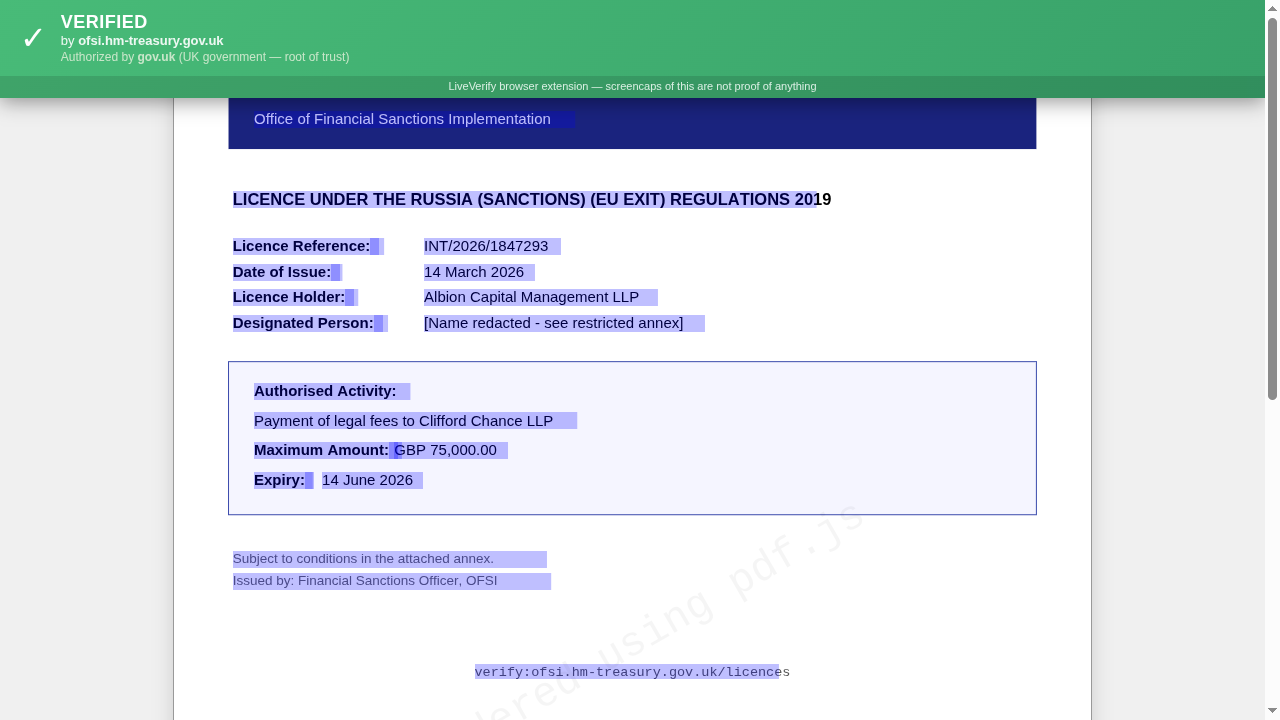
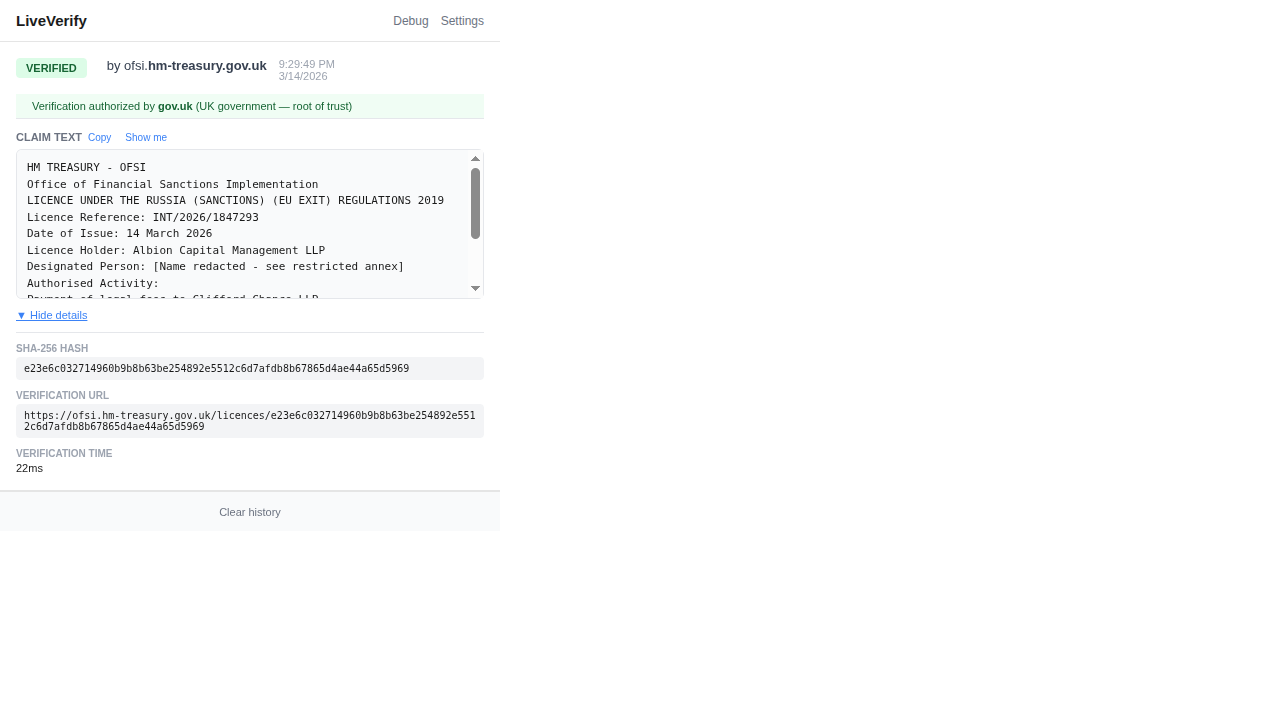
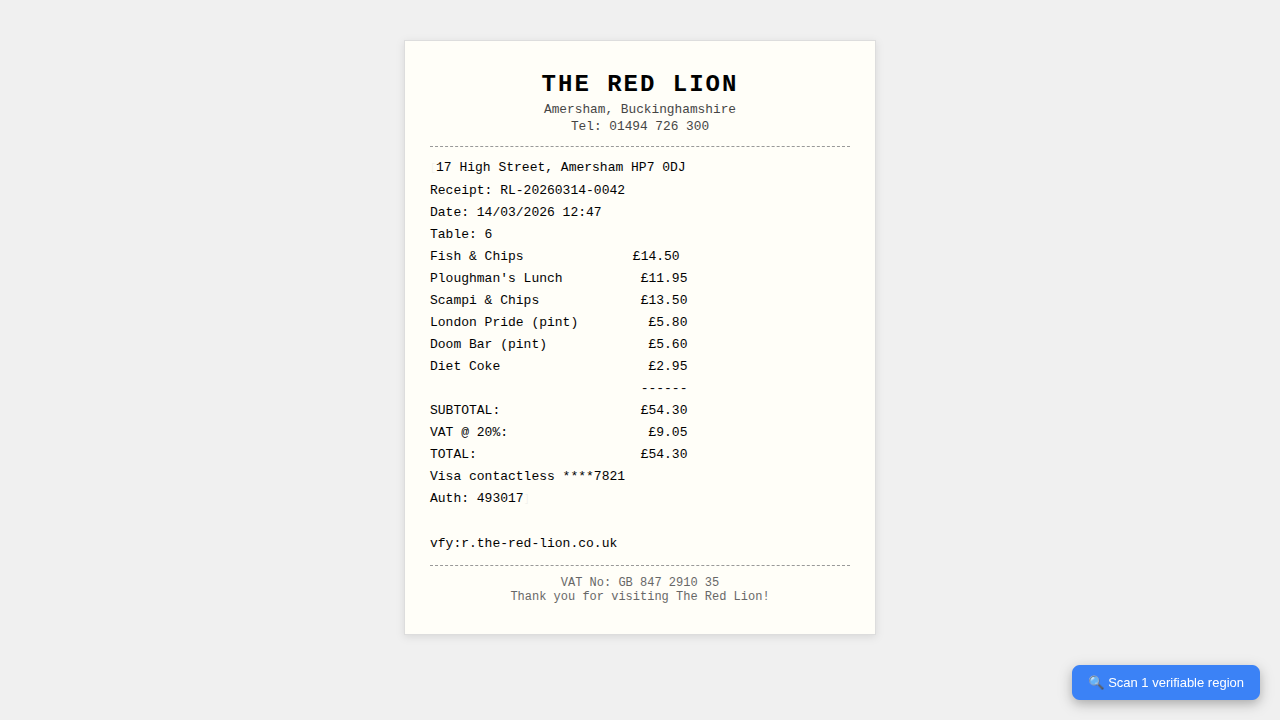
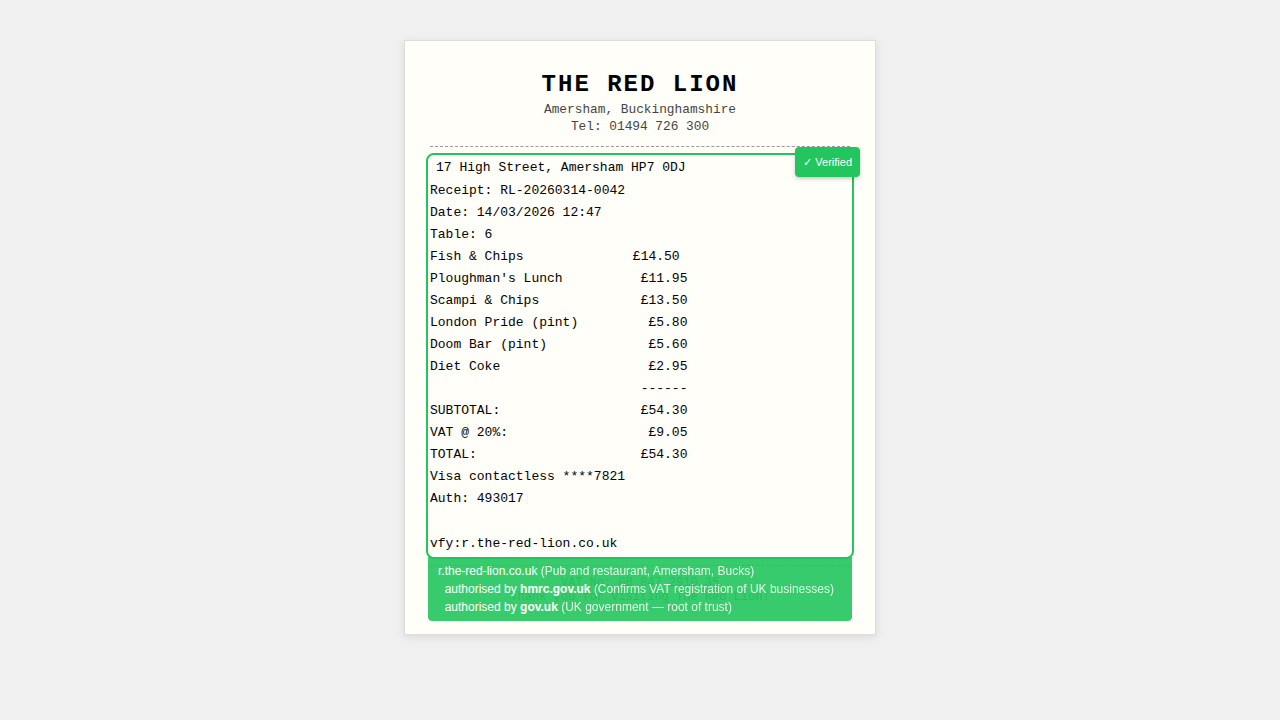
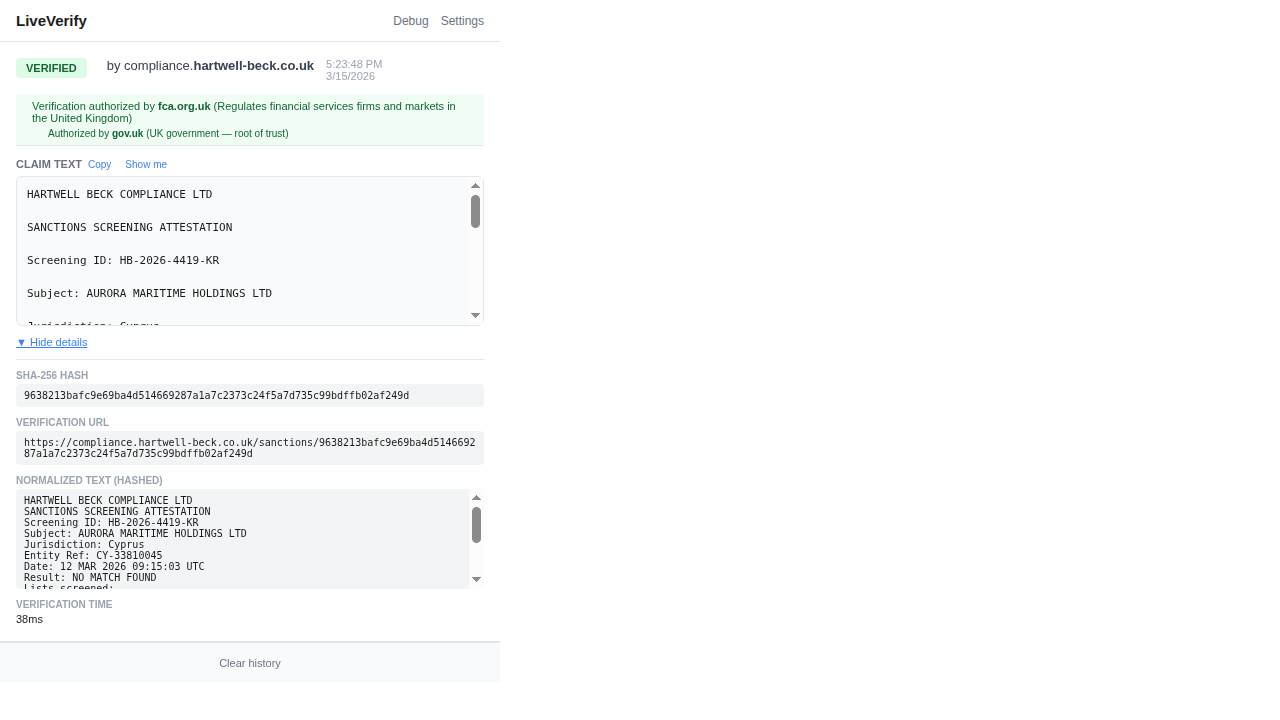
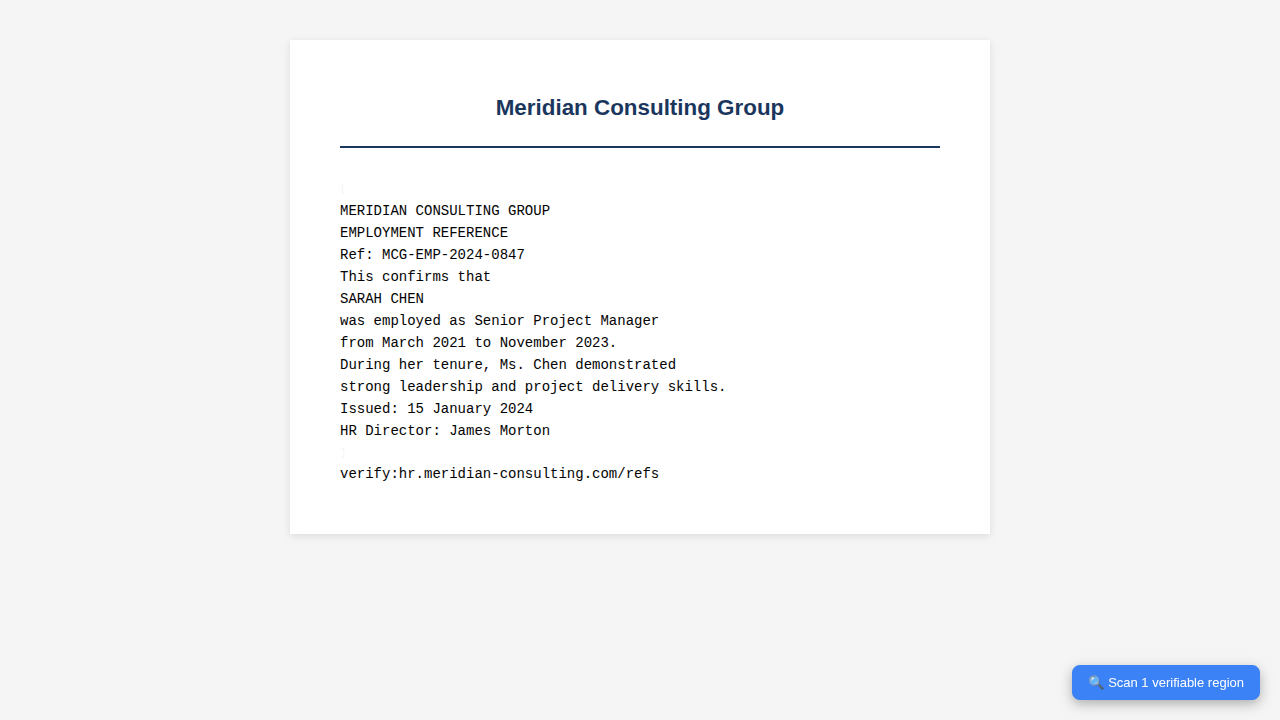
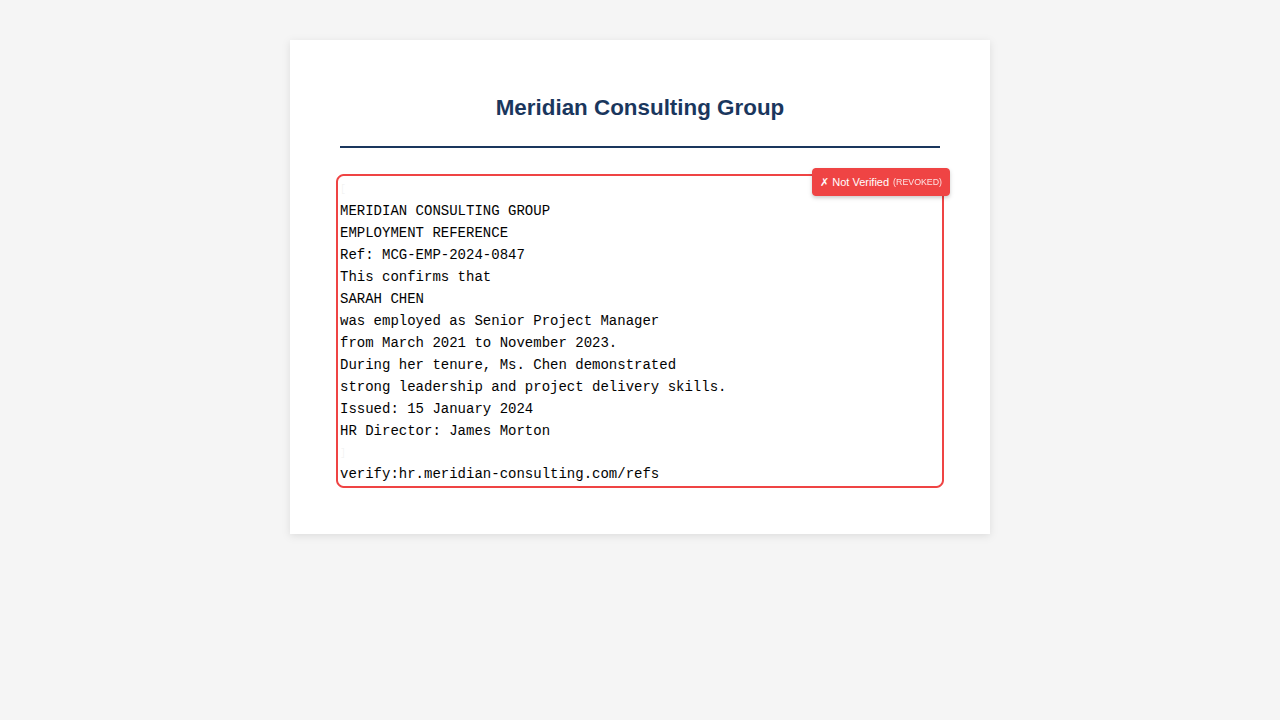
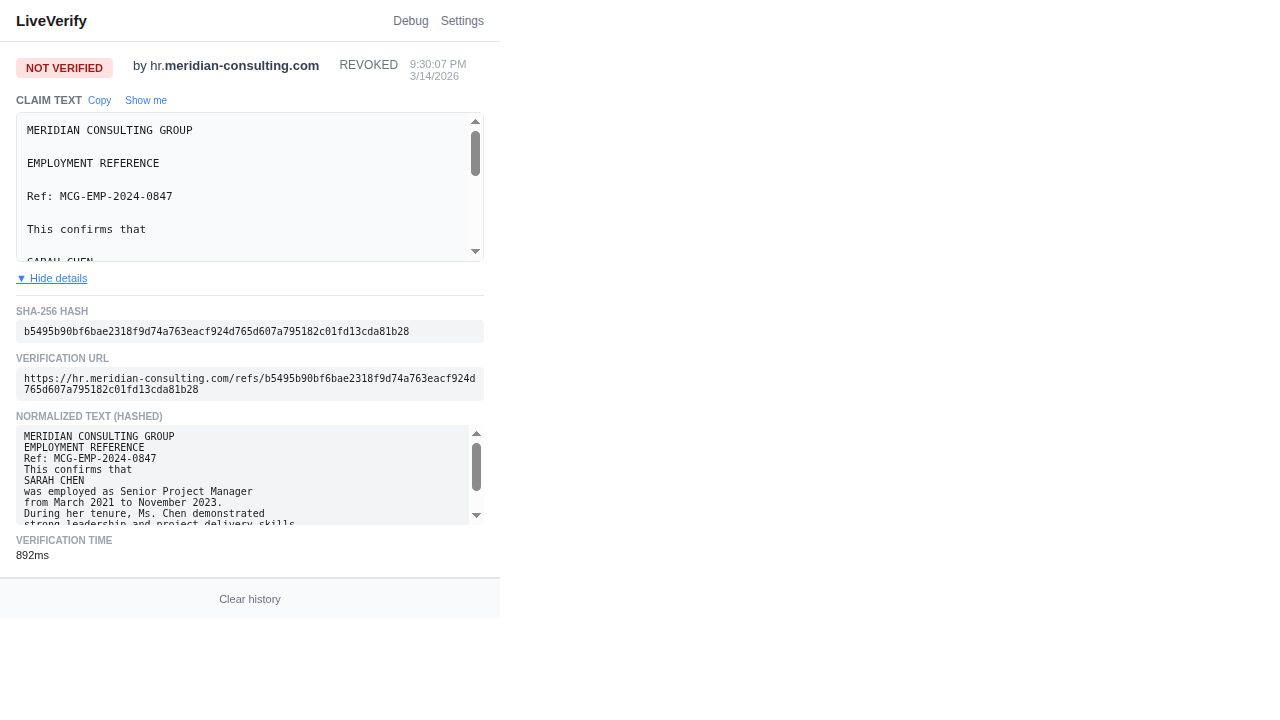
Screenshots captured by Playwright during automated tests against simulated authority chains in Docker. All organisations and people are fictitious. The Chrome extension is being itself or simulating something built-in to Outlook, Adobe or operating systems.
Clip mode (browser extension)
Install LiveVerify from the Chrome Web Store — published now, works in Chrome and Edge. (about the extension)
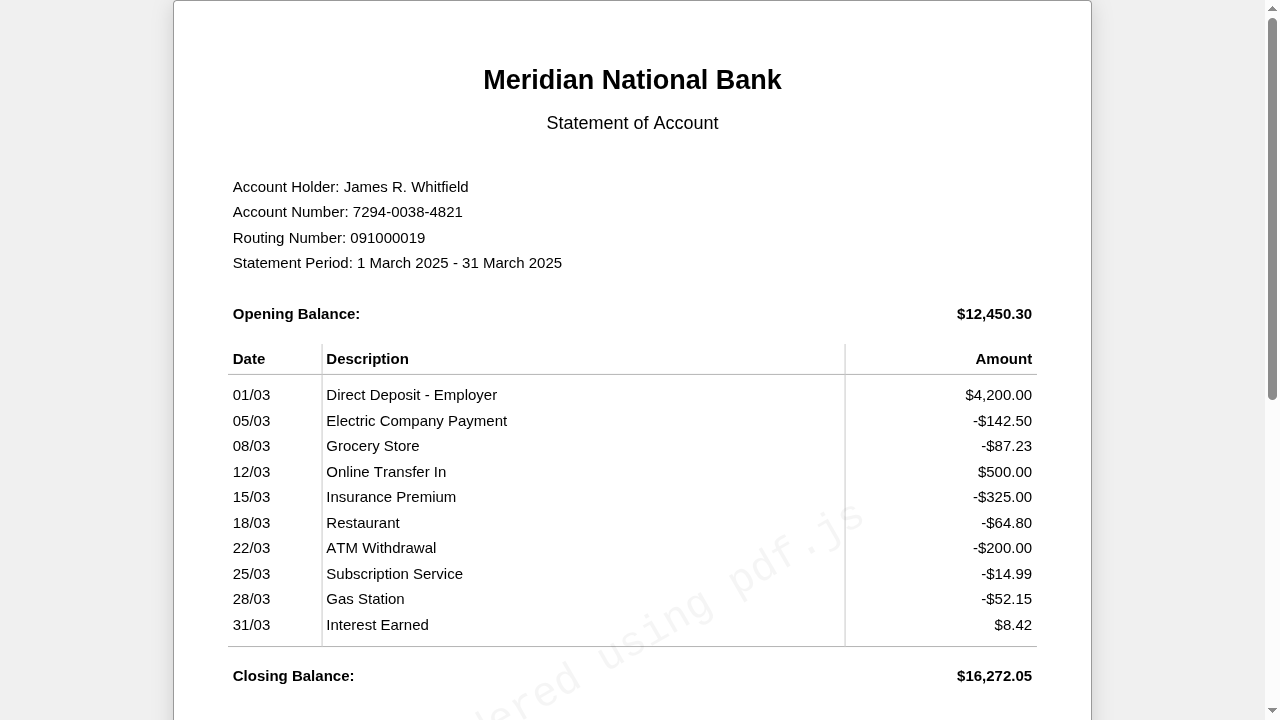
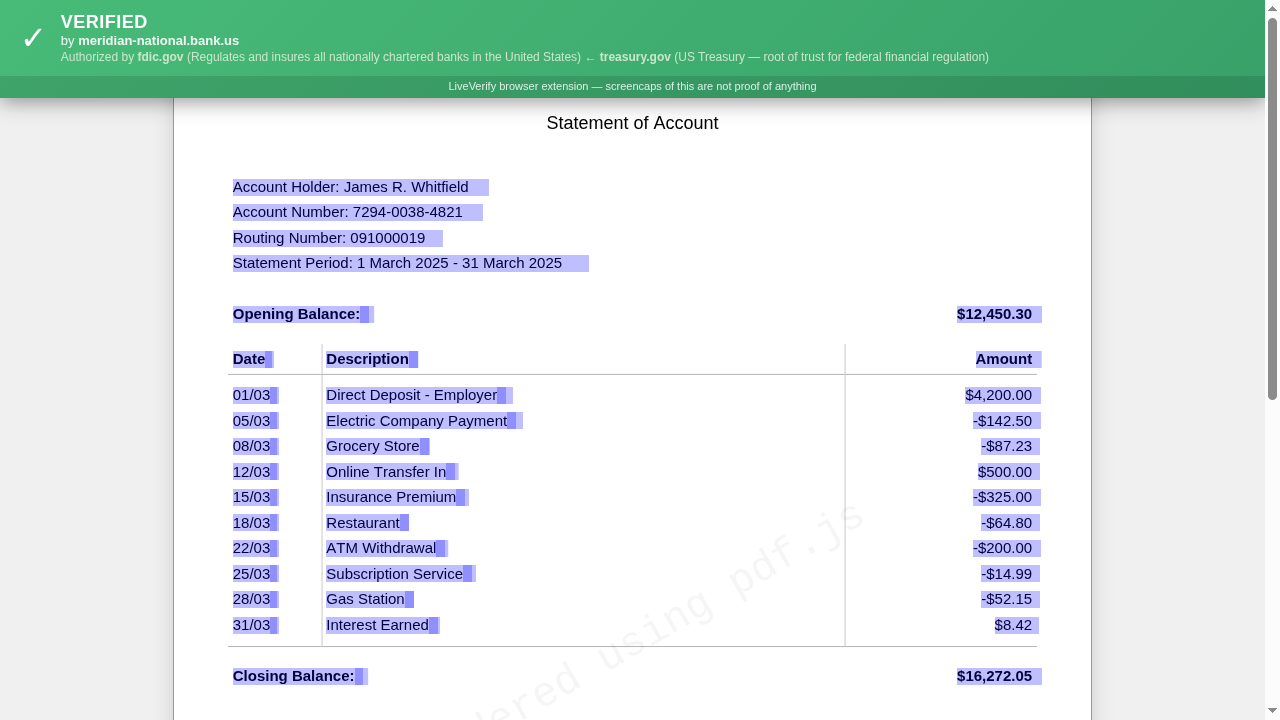
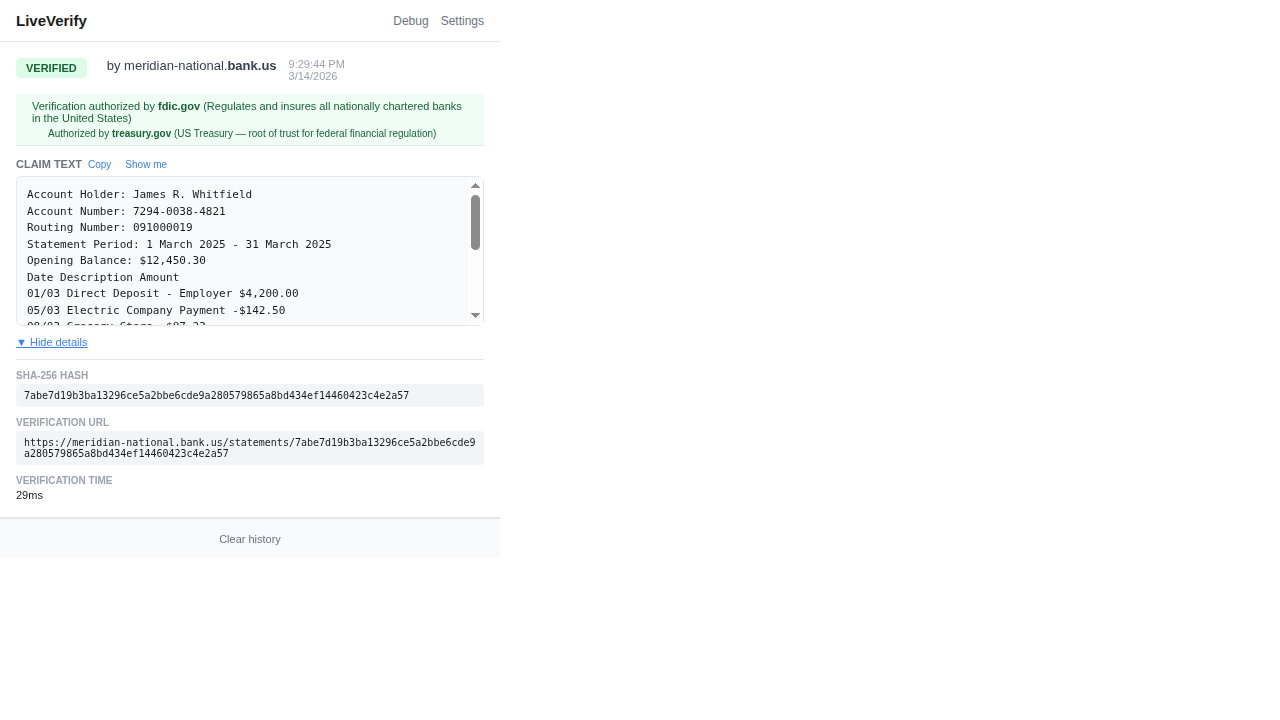
Bank statement (James, FDIC/Treasury chain)
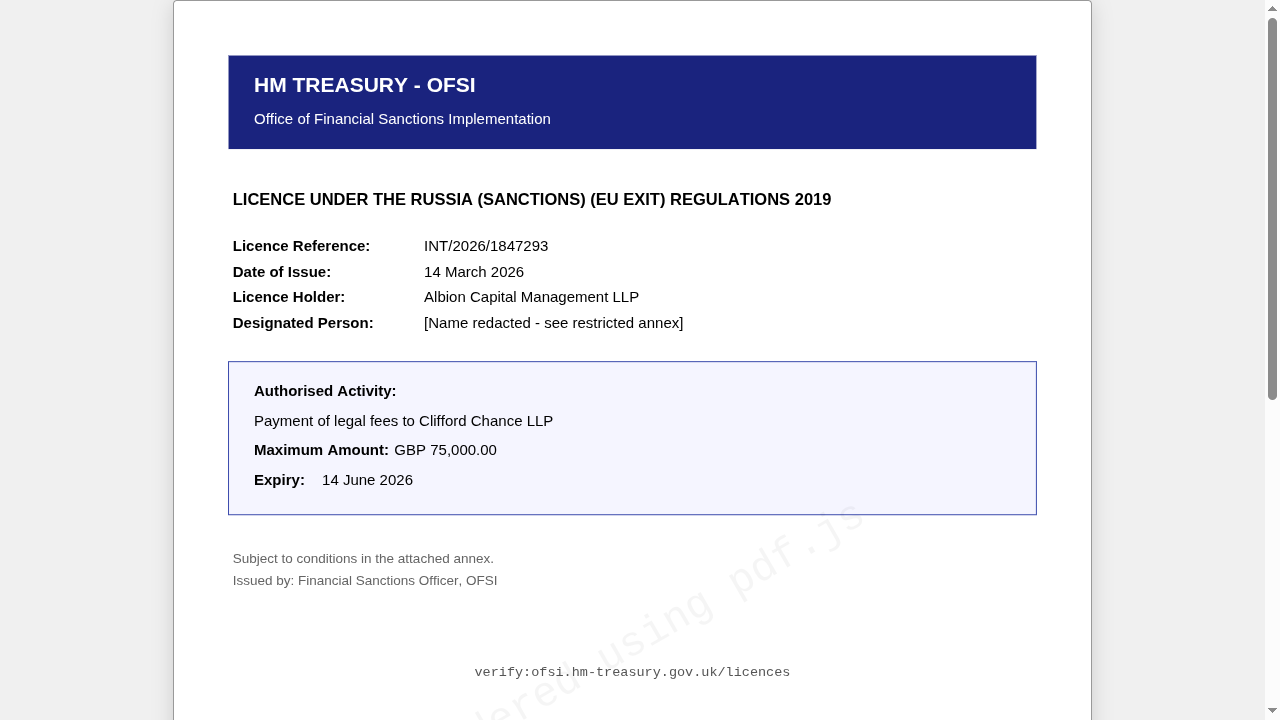
OFSI sanctions licence (UK gov chain)
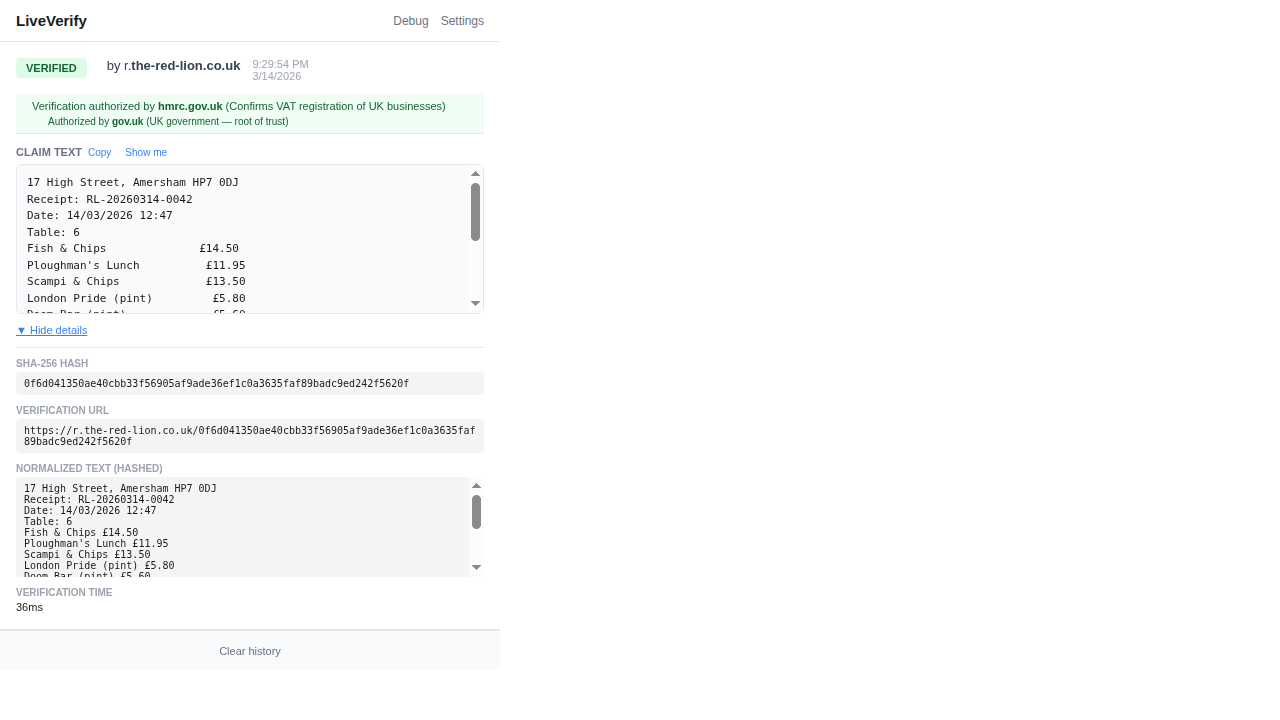
Pub receipt (Red Lion, HMRC VAT chain)
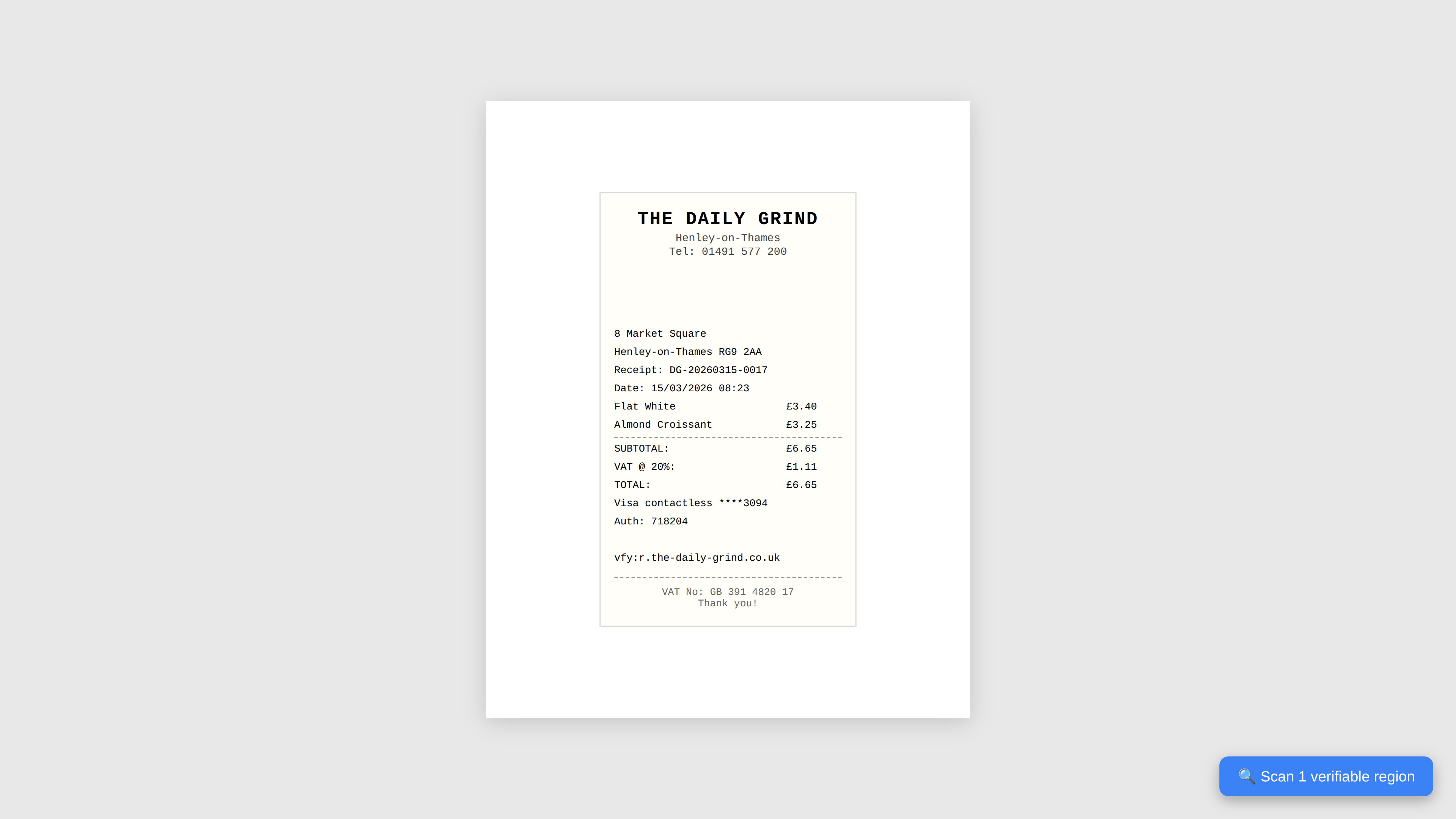
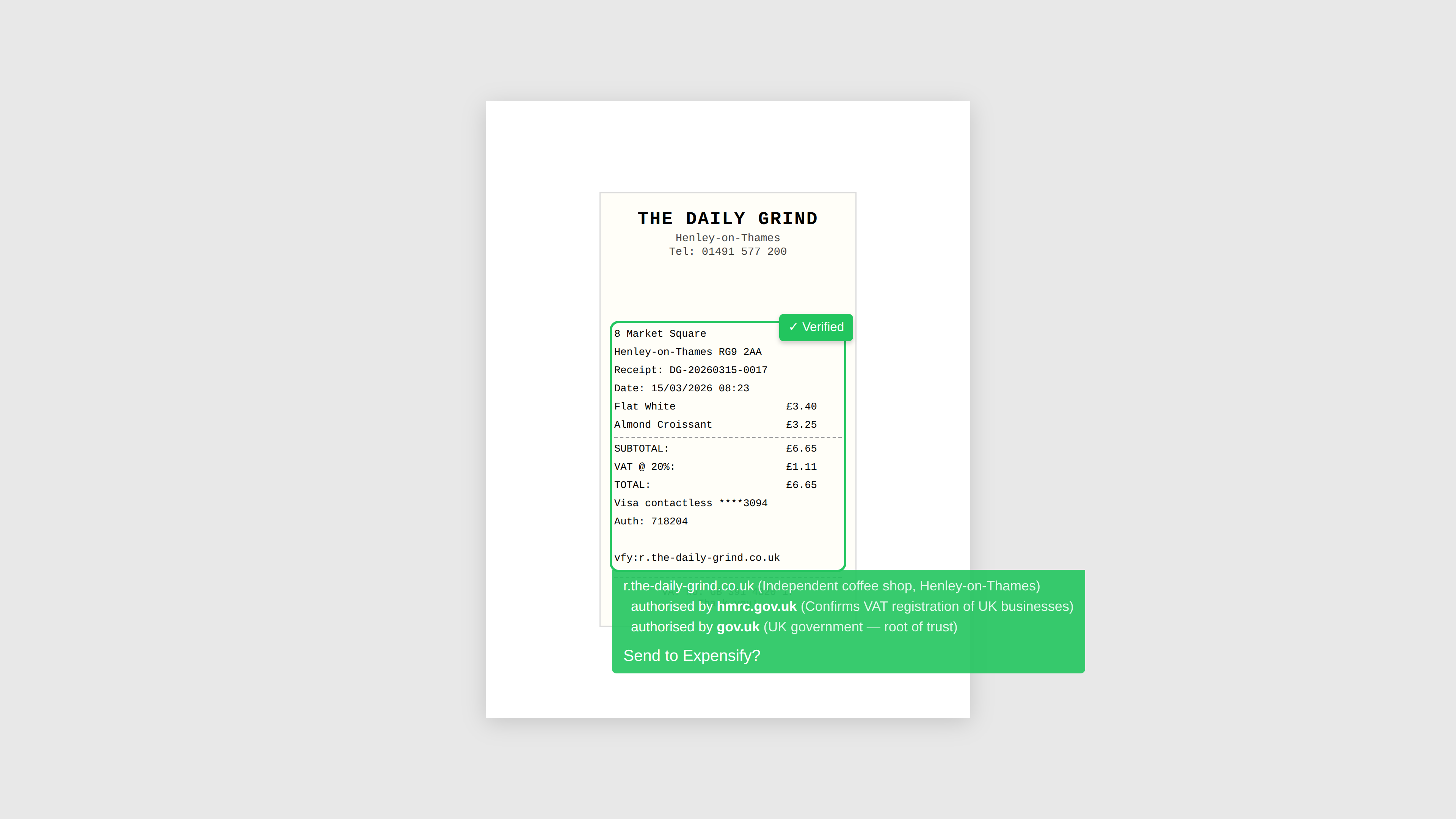
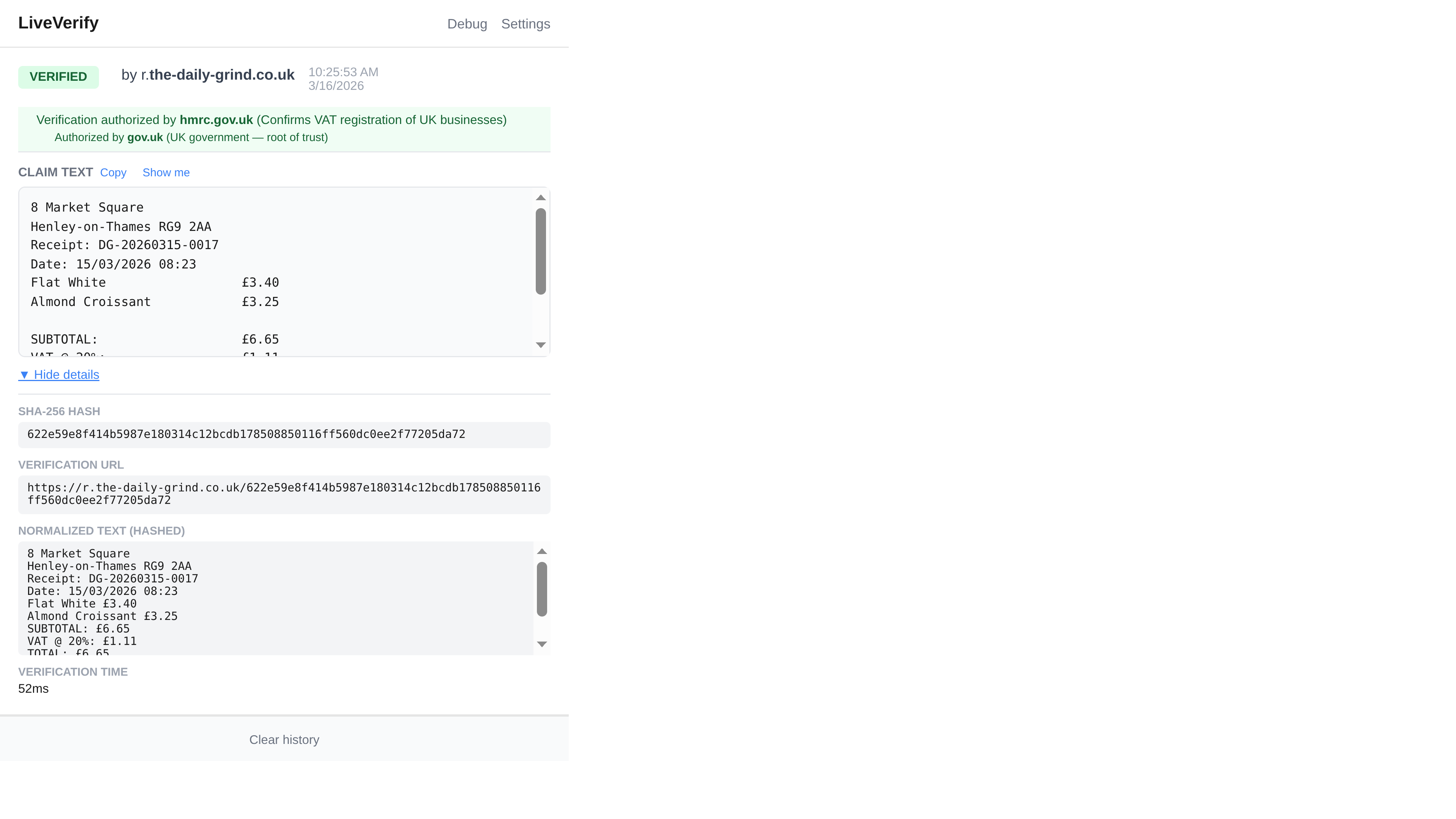
Coffee shop receipt (The Daily Grind, HMRC VAT chain)
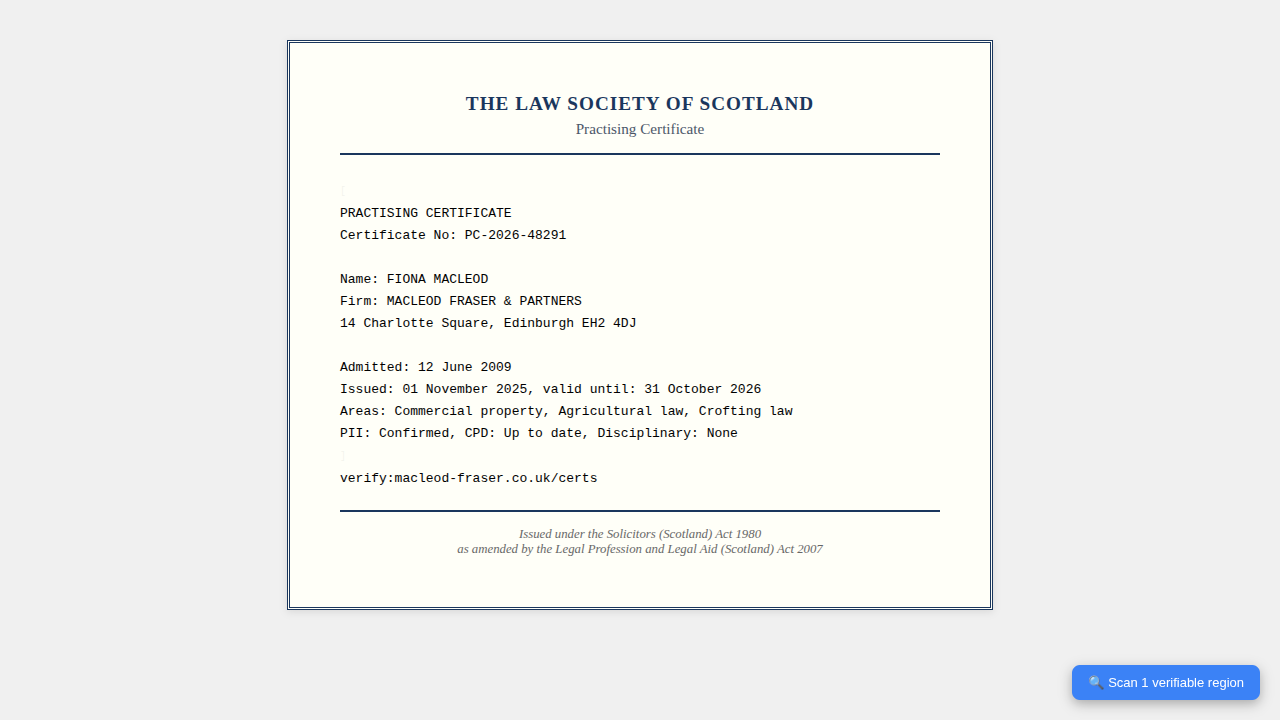
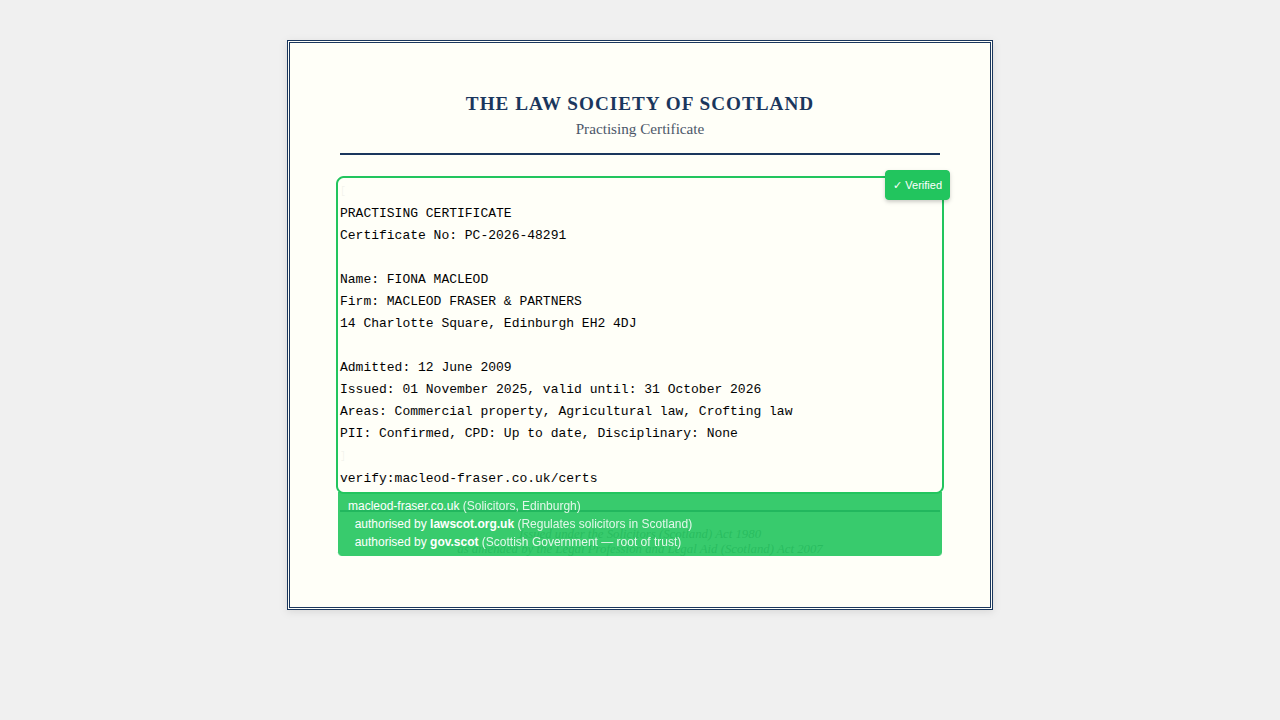
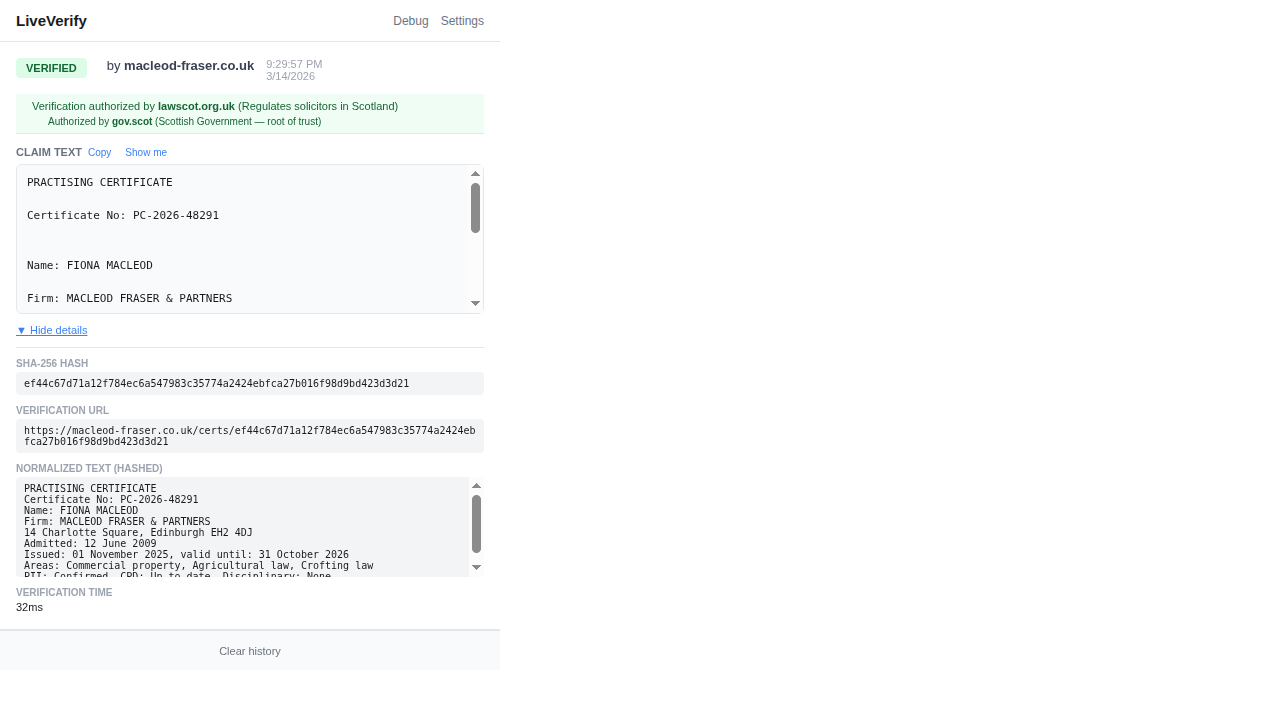
Scottish solicitor practising certificate (Law Society → gov.scot)
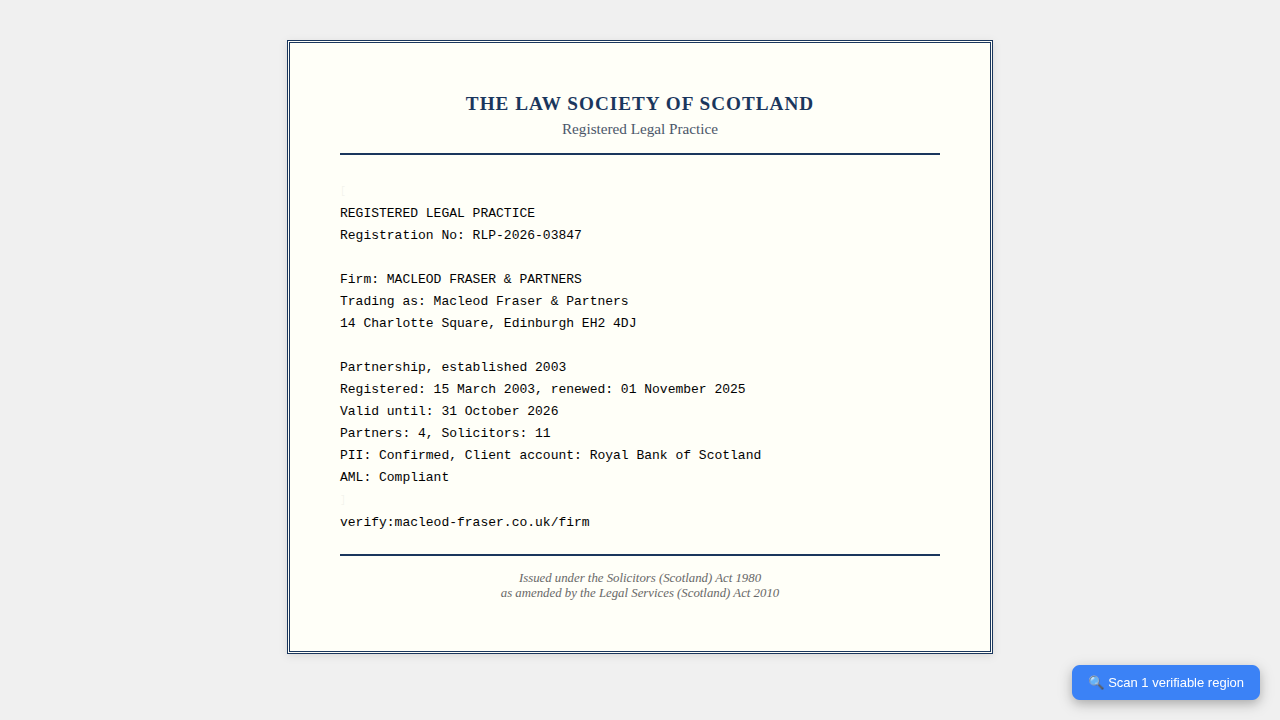
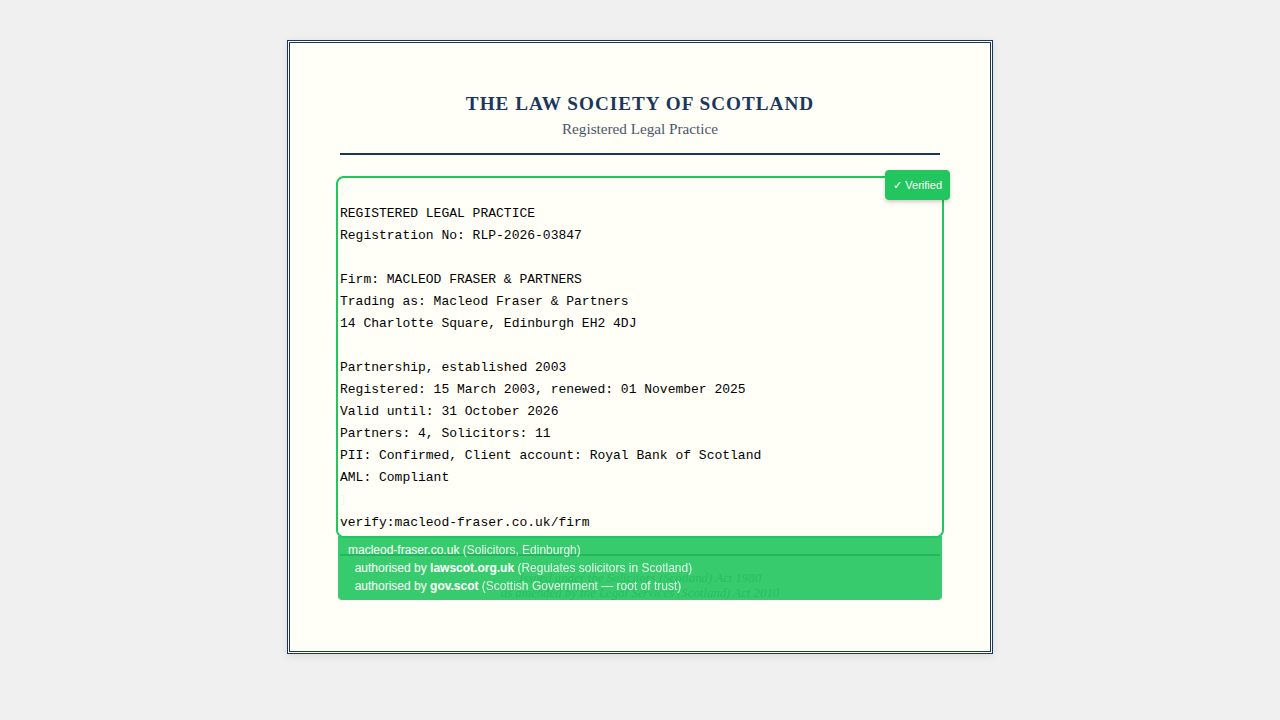
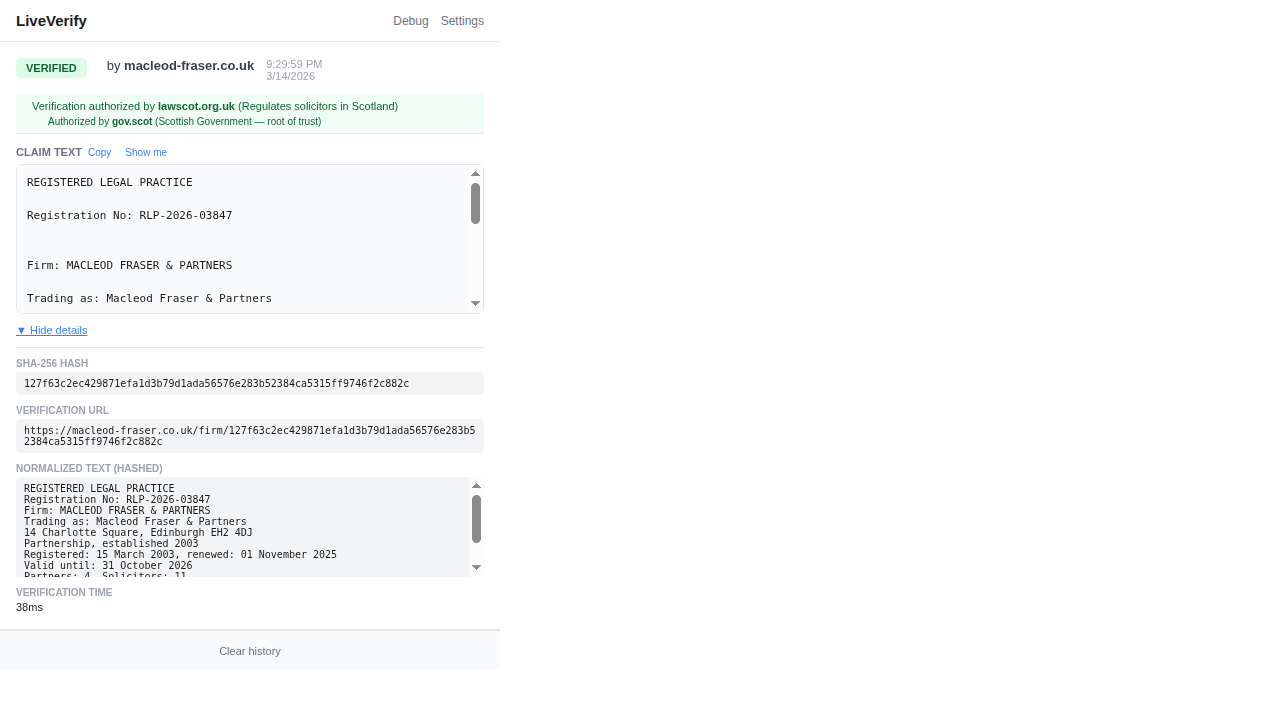
Scottish solicitors firm registration
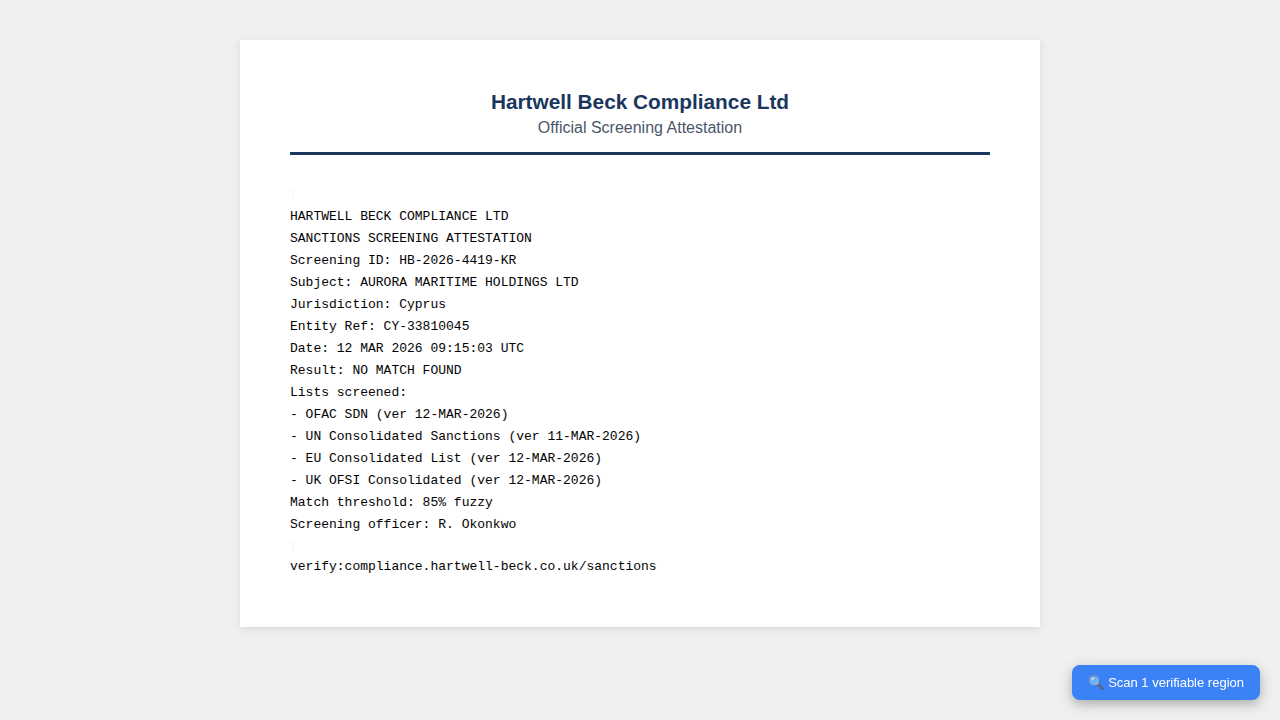
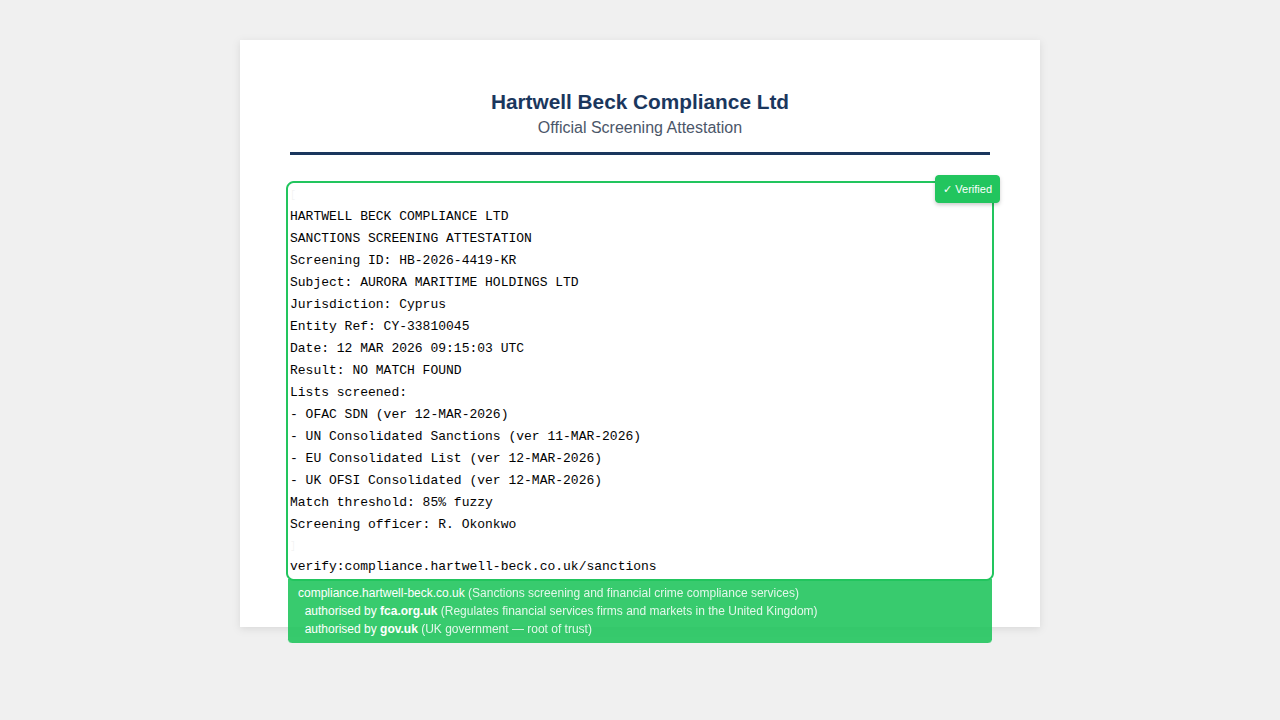
Sanctions screening attestation (FCA chain)
Camera mode
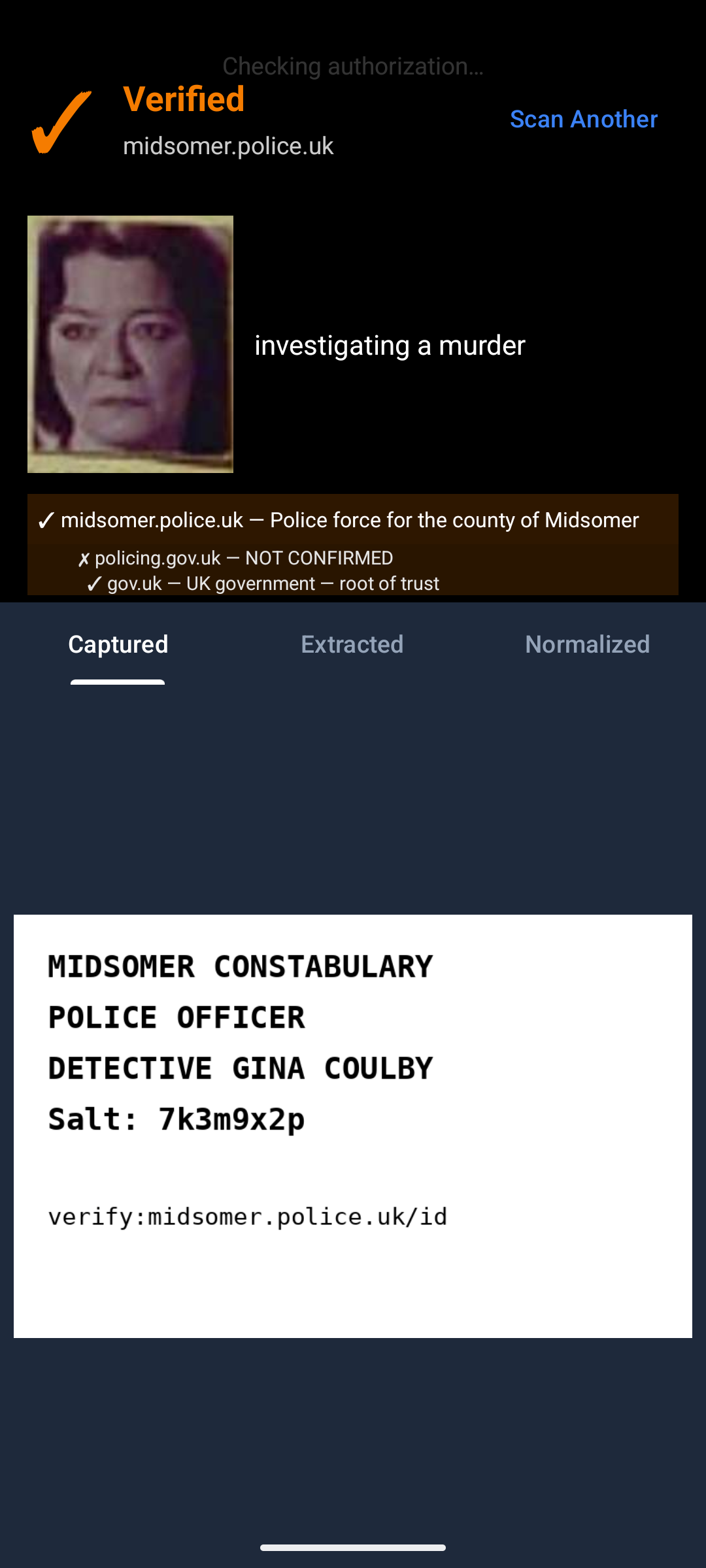
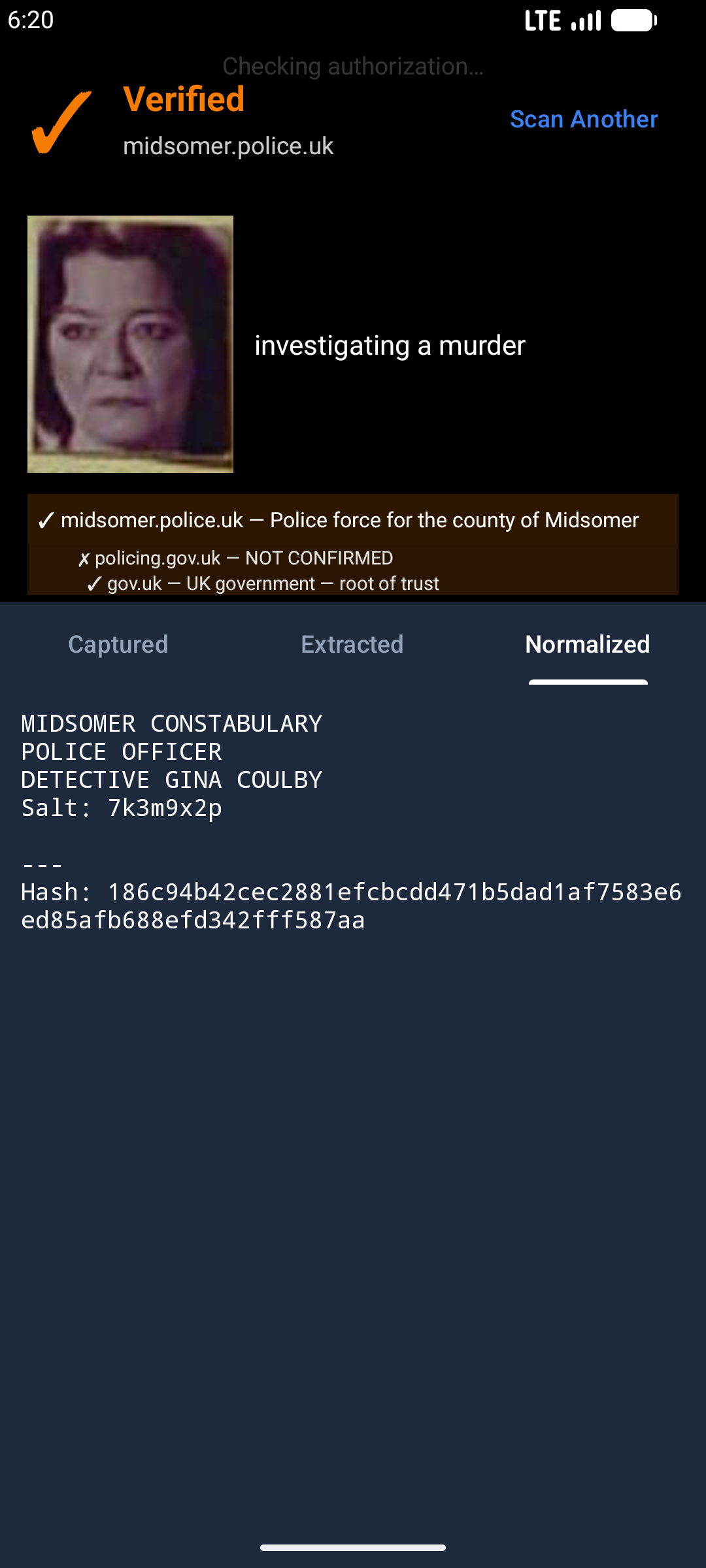
Police ID verified (Gina Dallimore, Midsomer police)
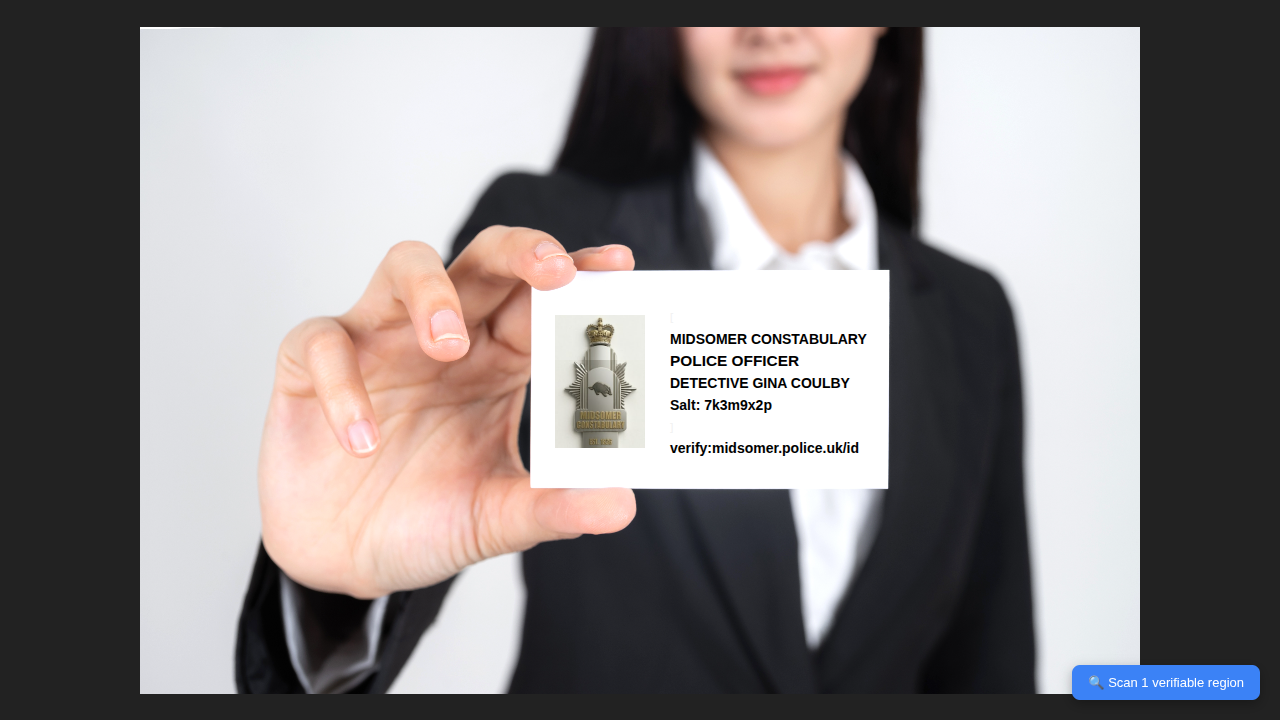
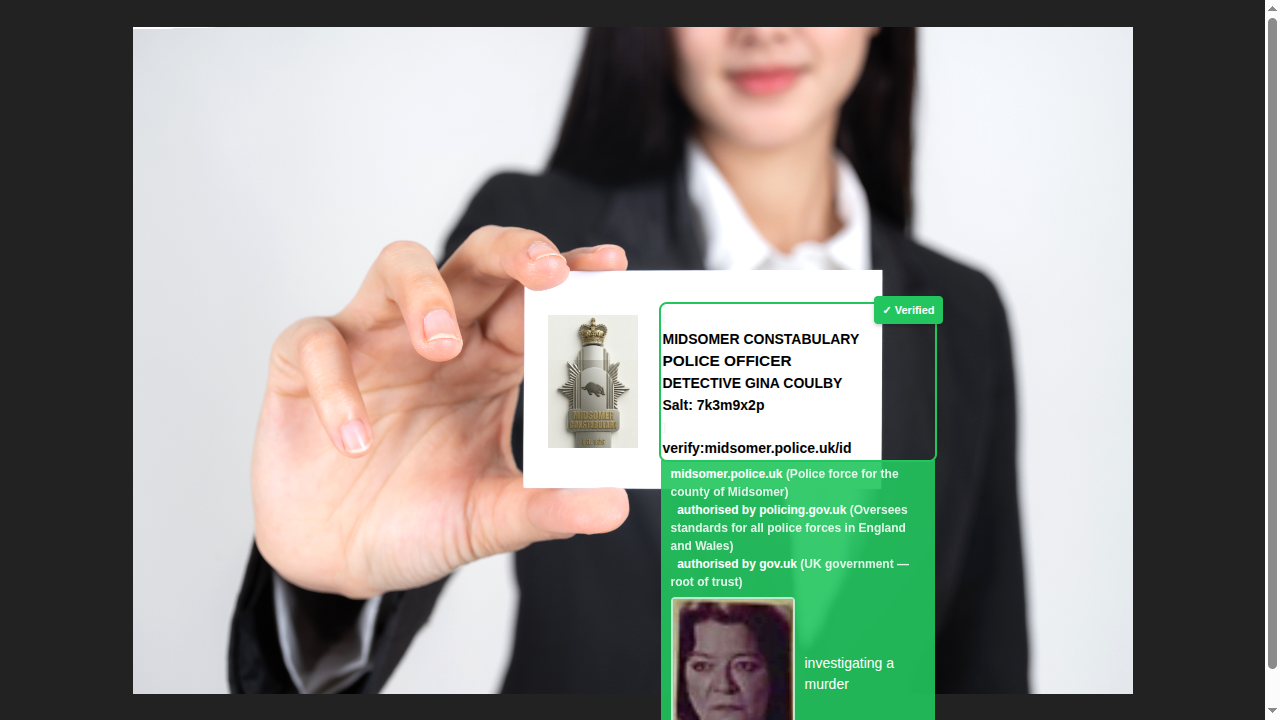
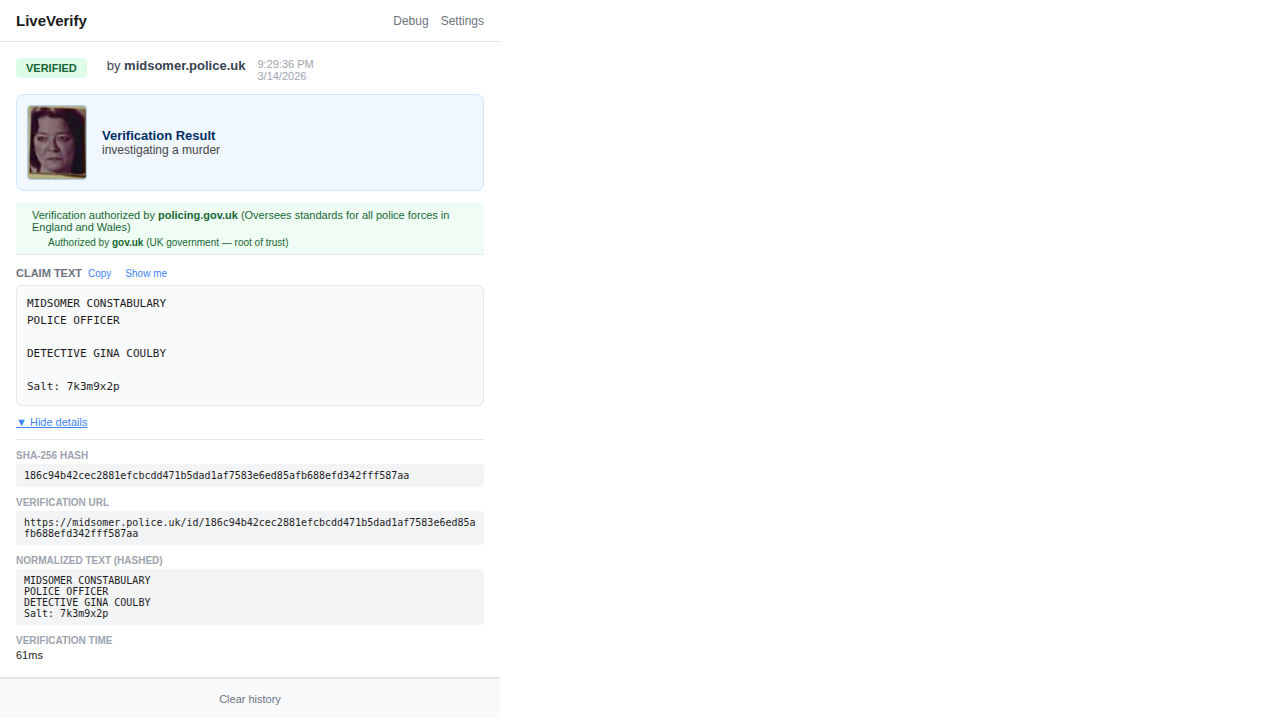
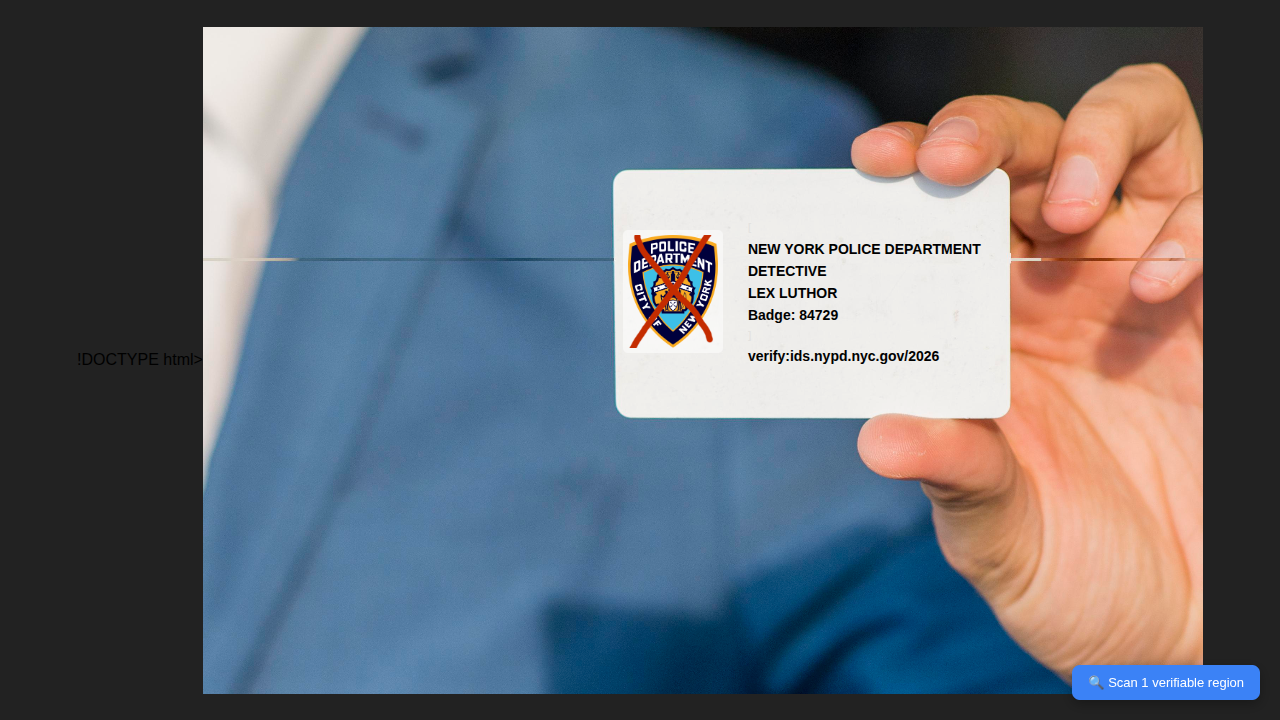
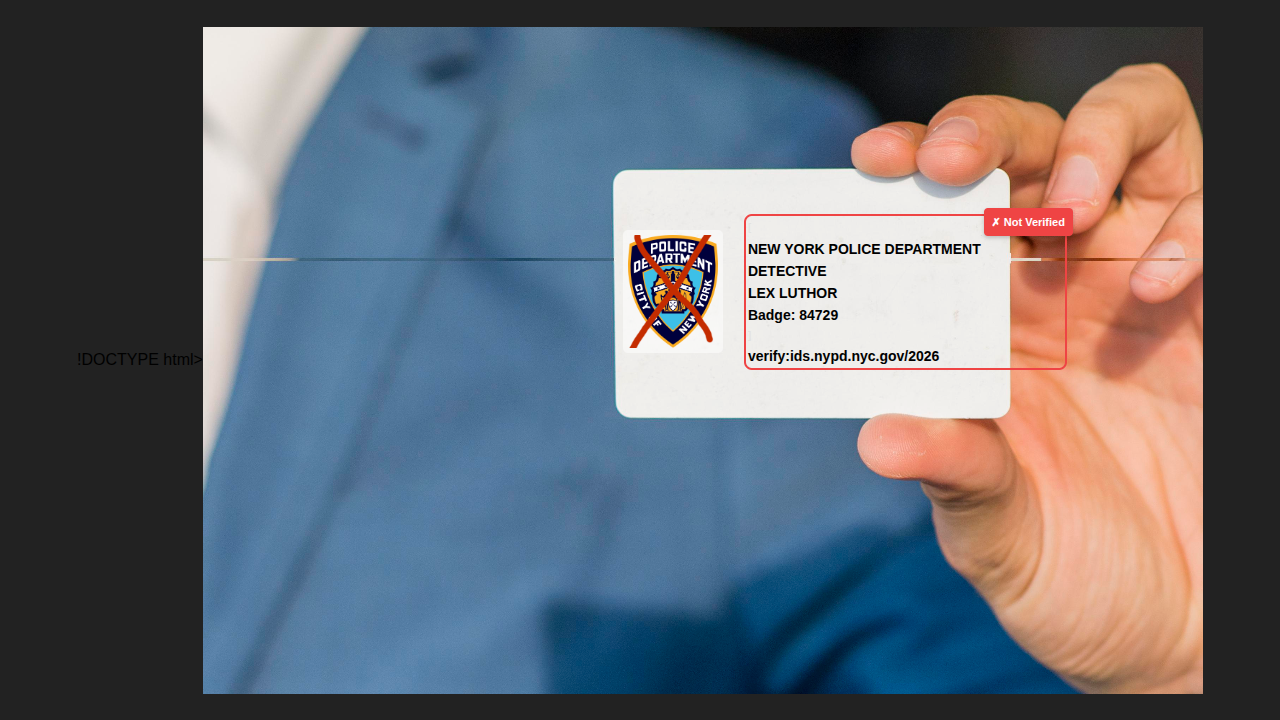
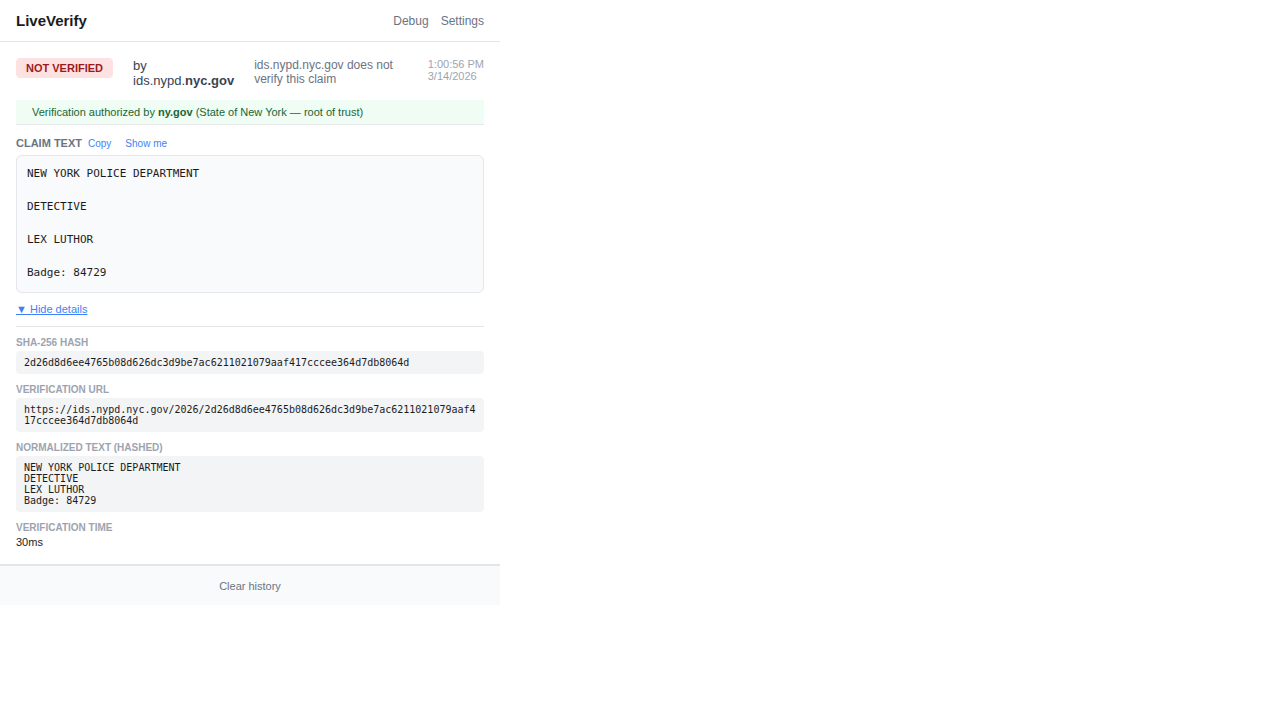
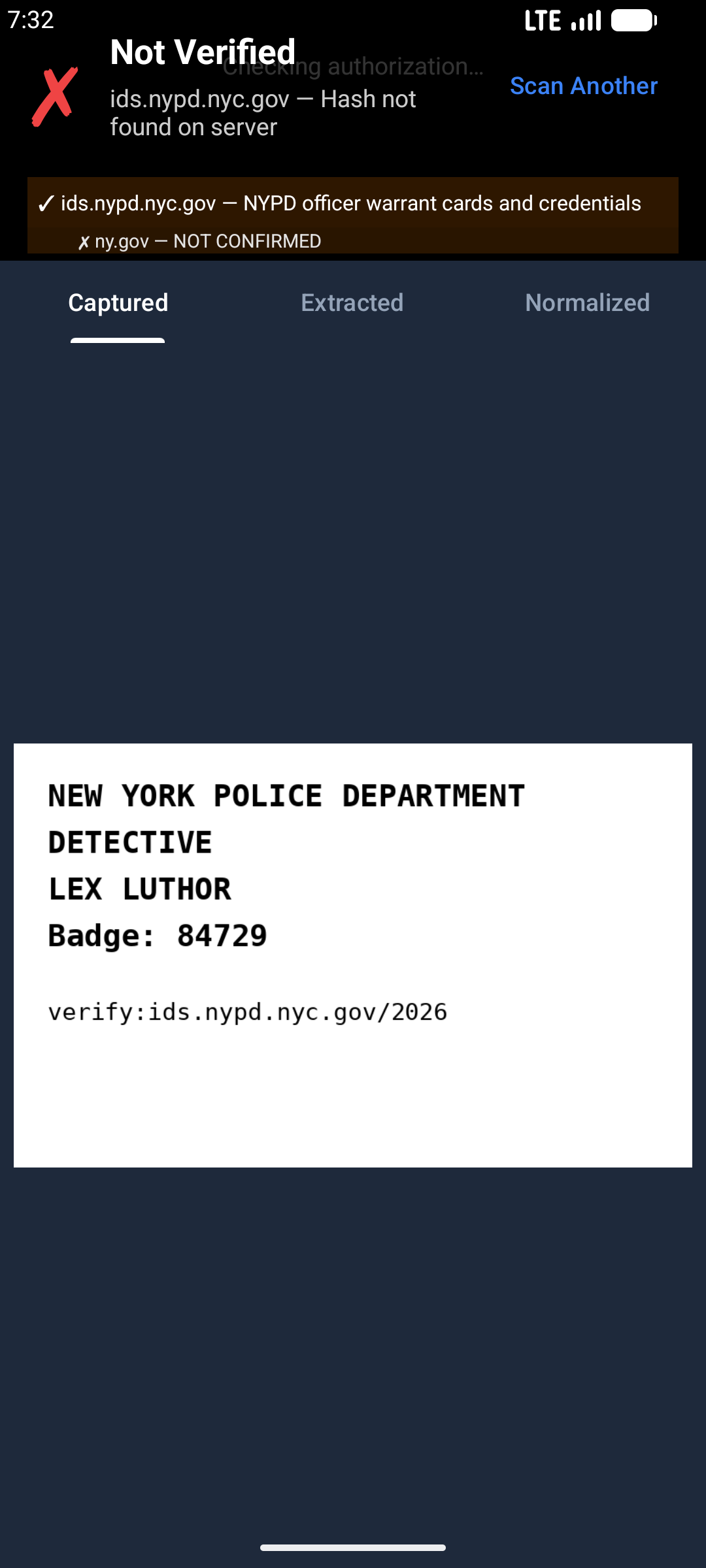
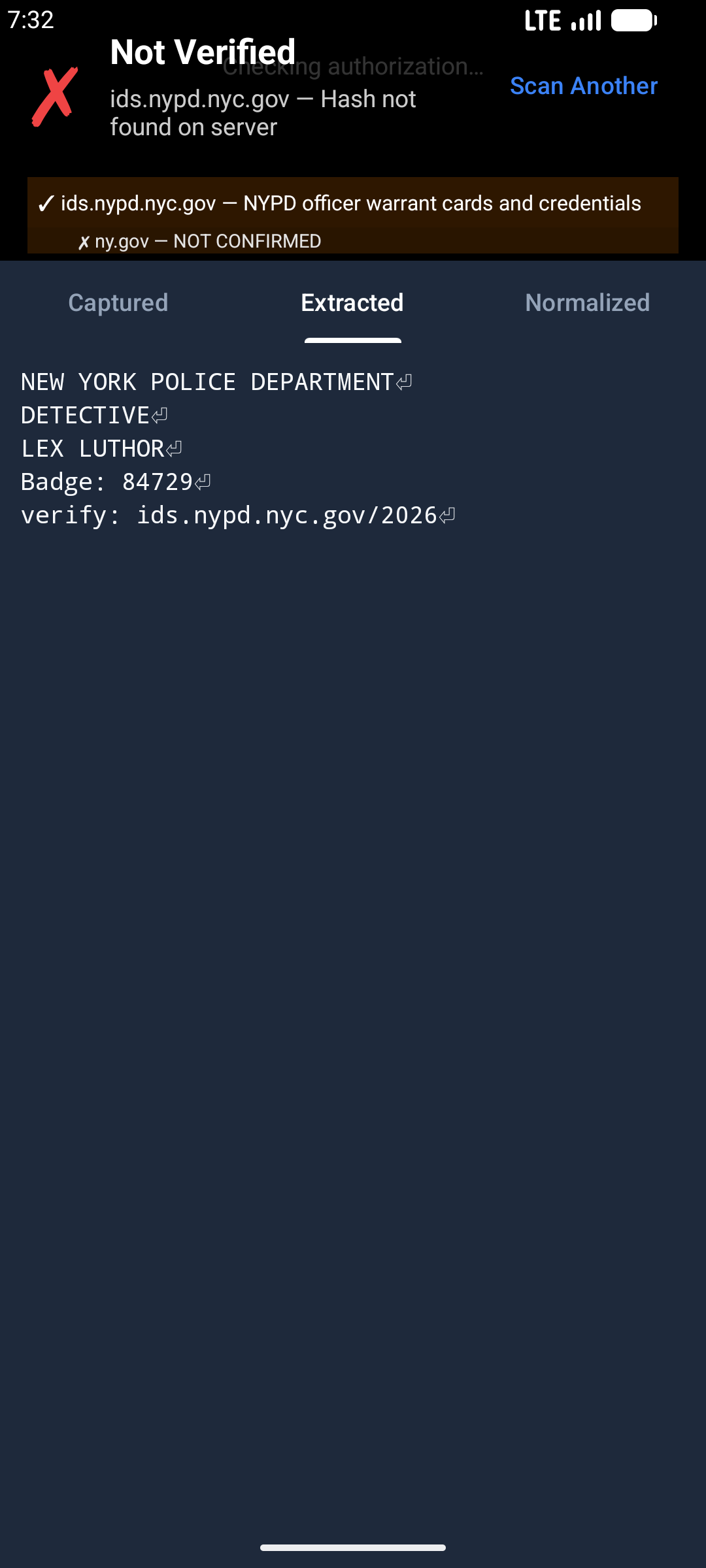
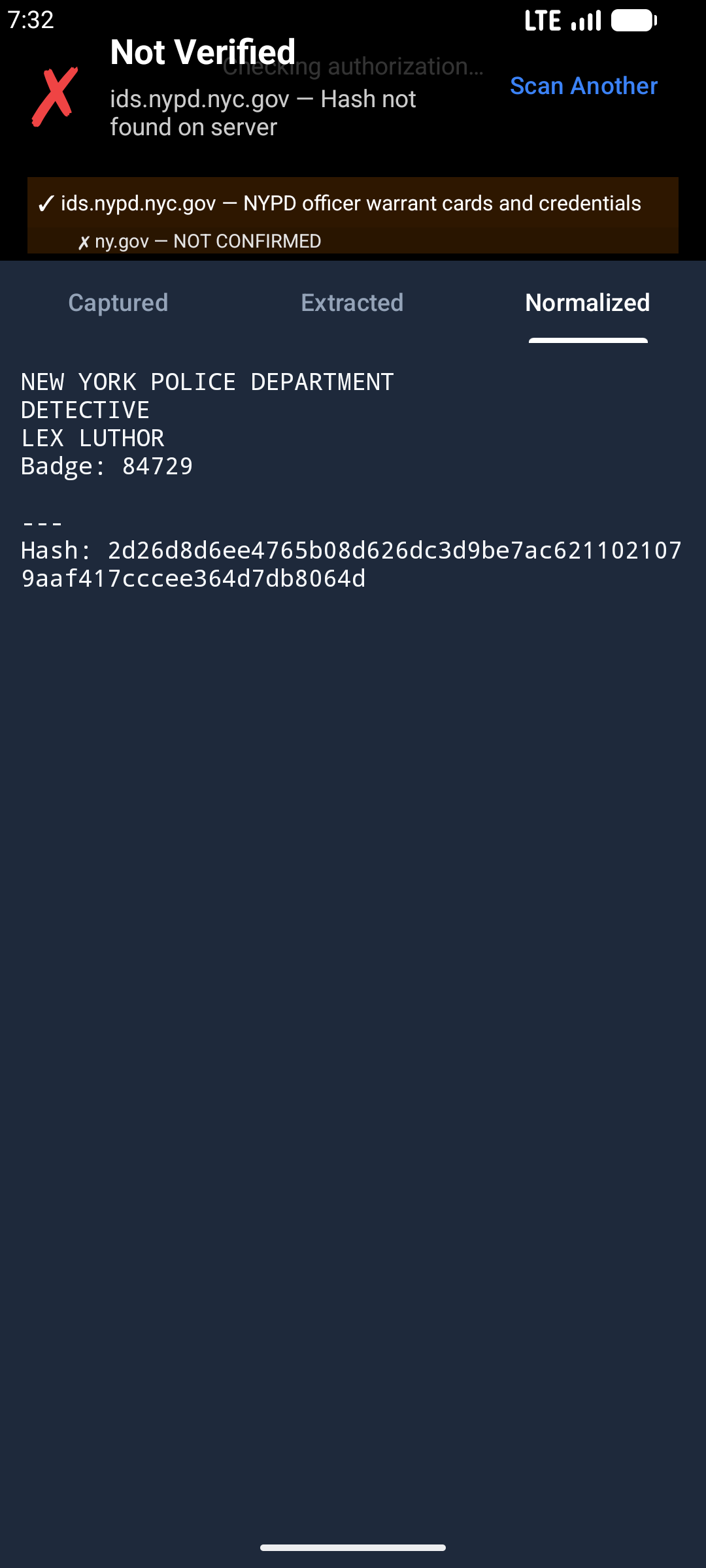
Fake police ID rejected (Lex Luthor, NYPD)
Police ID verified (Gina, Android emulator zoomed in)
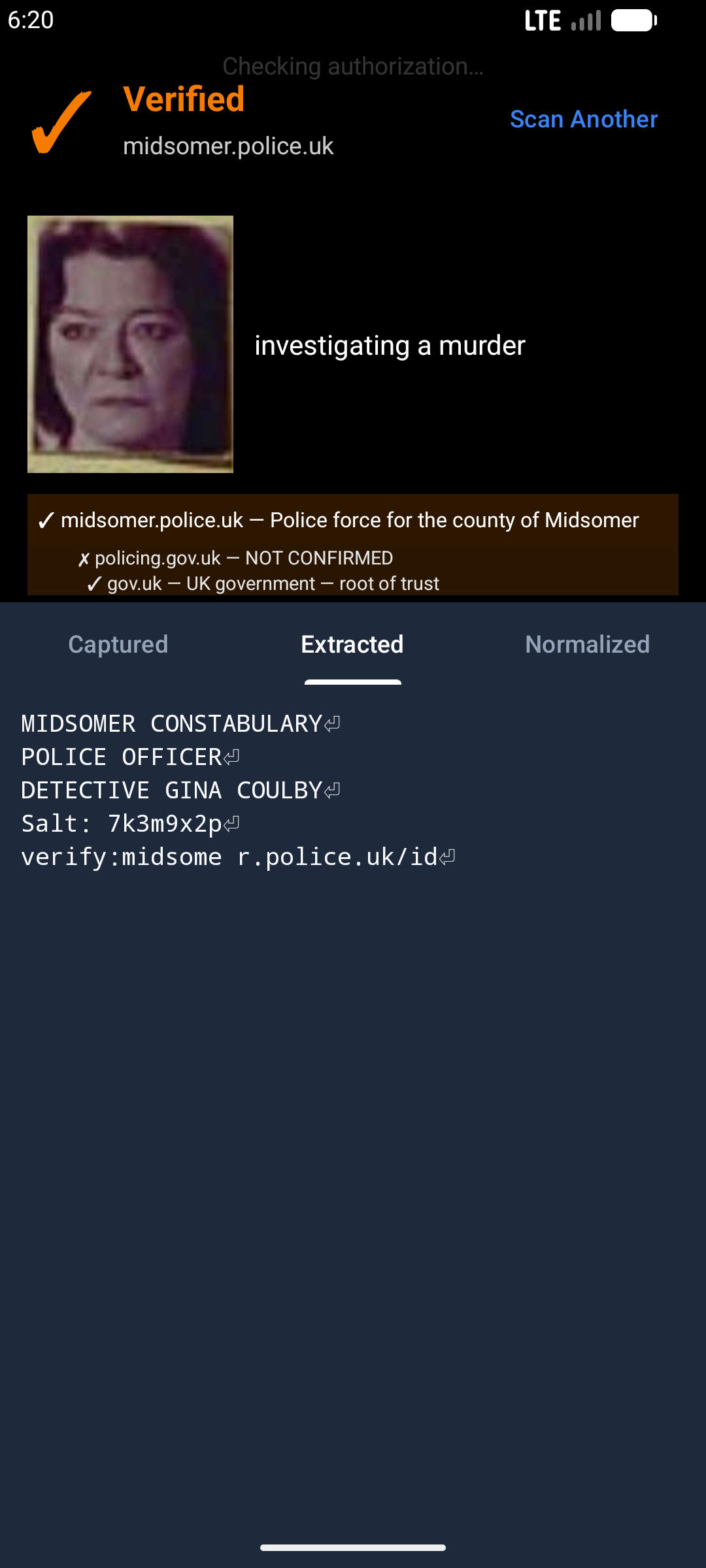
Fake police ID rejected (Lex, Android emulator zoomed in)
Coffee shop receipt OCR (The Daily Grind, Android emulator) — not yet passing
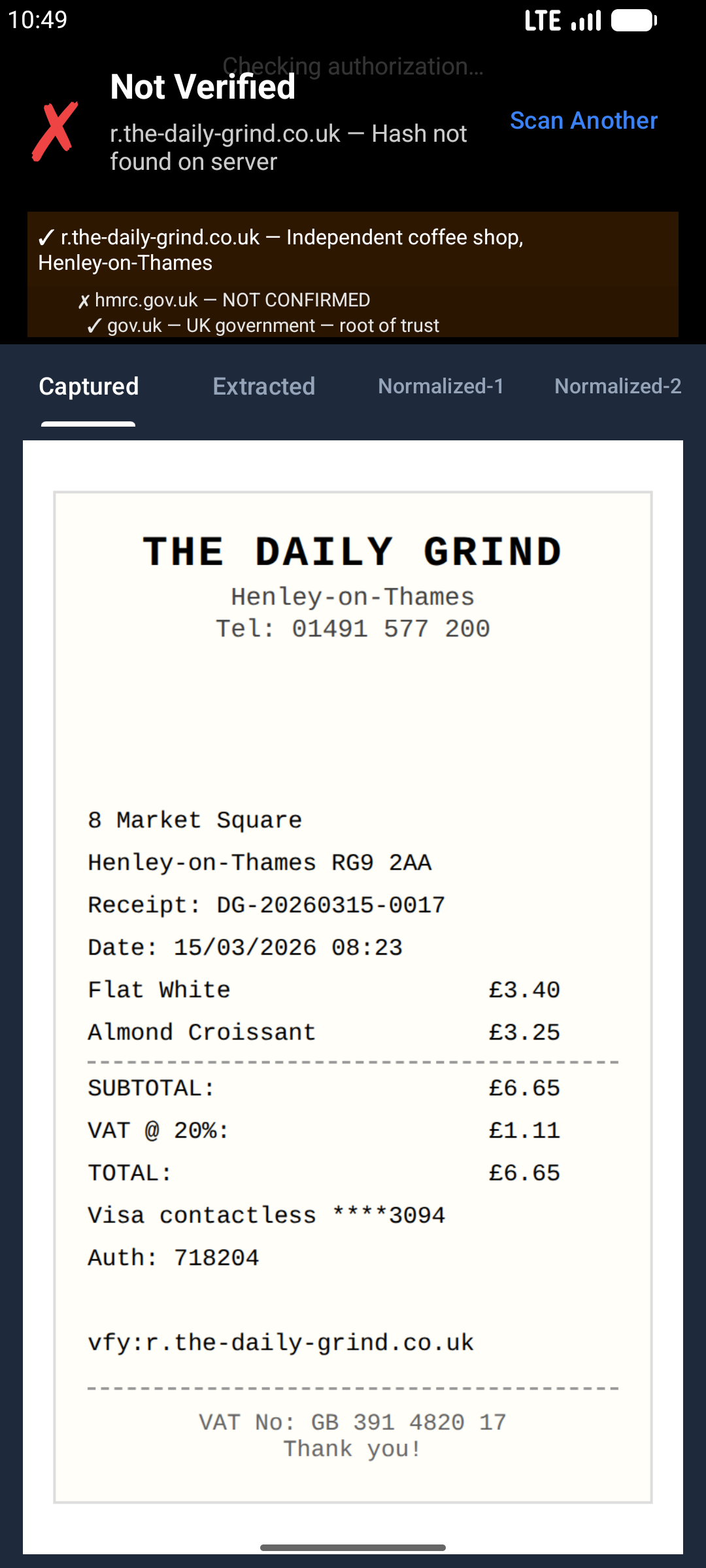
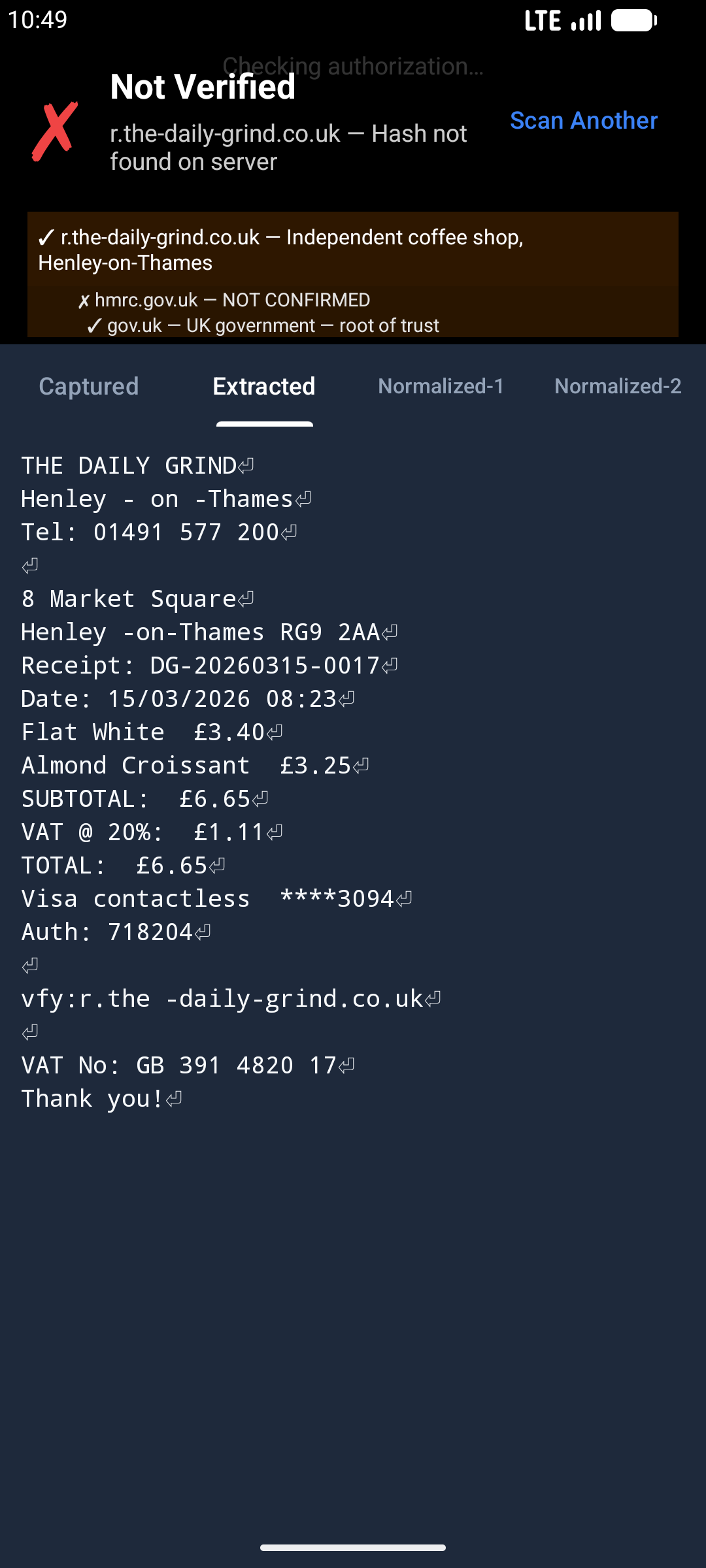
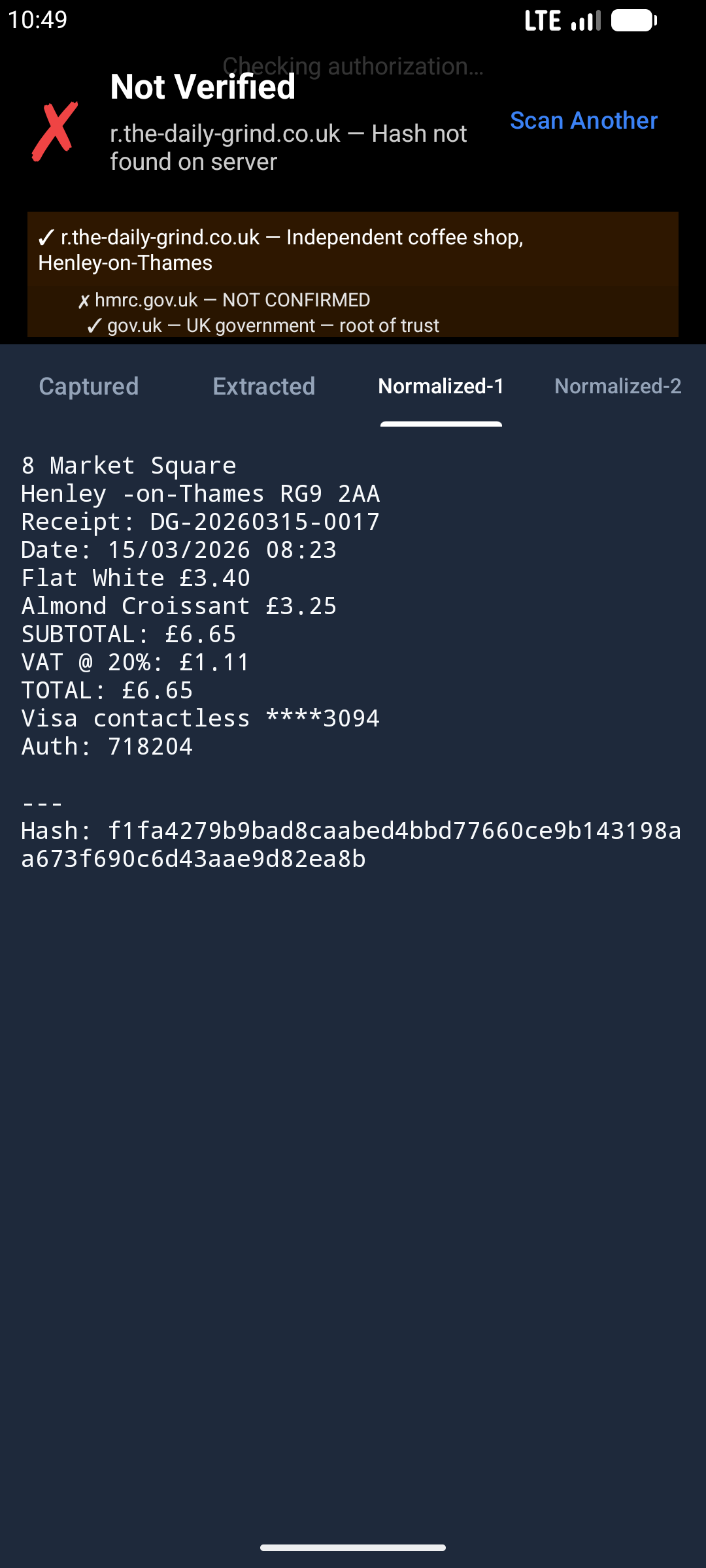
Hash lookup fails due to Google ML Kit OCR errors: Henley -on-Thames (spurious space around hyphen),
TOTAL : (space before colon). Row stitching and iterative blank-line candidate search work correctly —
the remaining gap is OCR character accuracy. Apple Vision on iOS gets these right.
Privacy model
Text normalization + SHA-256 happen on-device (Clip mode never sends your text anywhere; Camera mode runs OCR on-device too). The only network step is a hash lookup. The science of one-way hashes is explained at one-way-hash.html, and we go into the rest of the guarantees in the Privacy Declaration.
Does this depend on one person sticking around?
No — by design. It's an open standard (Apache 2.0), publicly disclosed as unpatentable prior art, with no trademark to capture. Every verification endpoint is a static file on the issuer's own domain, not on any infrastructure this project runs. If the project stopped tomorrow, every deployed endpoint keeps answering, and anyone can carry the spec forward. That's the opposite of the usual “what if the vendor disappears?” risk.
The flip side of being unpatentable: there's no exclusivity to sell, and no licence fees to collect — so there's no obvious way for the work to fund itself. If you find this useful and can help support it somehow, that would be genuinely appreciated. Get in touch.
Live Verify is an open standard begun by Paul Hammant, prompted by the PPE Medpro / Intertek forgery case. Pilots, integrations, questions: paul@hammant.org